A baby sleep chart can’t tell you exactly how long your baby needs to sleep. Researchers don’t fully understand baby sleep patterns, let alone baby sleep requirements. But researchers have collected information from parents about their babies’ sleep habits, and based on these surveys, we have a pretty good sense of what’s typical — the normal range of variation that parents report.
In addition, experts have offered some broad guidelines about optimal sleep duration for older babies and toddlers. As we’ll see, these recommendations represent educated guesswork, and they are rather vague. But they can help us identify the range of sleep times that are linked with better behavioral and health outcomes.
So what does normal sleep look like in babies? When should you be concerned that your child isn’t sleeping enough? And what can parents do to help babies and toddlers sleep longer? Here I’ve put together a baby sleep chart based on a combination of sources. For each age range, it summarizes the sleep behavior that most parents encounter. Next, we discuss where the numbers come from, and the challenges of obtaining accurate information about baby sleep times. Finally, we’ll go over those expert recommendations, and some tips for coping with babies who are “short sleepers.”
Typical sleep times by age: How much time do babies spend snoozing?
As you might expect, newborns sleep a lot – often as much as 16-17 hours per day, especially during the first couple of weeks postpartum. And, as babies get older, total sleep duration decreases (e.g., Pecora et al 2022). But there’s a considerable range of sleep times among different individuals, and it’s helpful to drill down beyond a single number representing the “average” baby. Here’s my summary of the data on parent-reported sleep behavior.
0-2 months
- Total sleep duration is 14-15 hours (average)
- Ranges between ~ 12-16 hours for about half the population*
- Ranges between ~ 9-20 hours for about 95% of the population
- Most parents report multiple night wakings
- Total nighttime sleep duration approximately 8-10 hours*
- Babies take 3-4 daytime naps (on average); more during the first weeks postpartum
3-5 months
- Total sleep duration is 13-13.5 hours (average)
- Ranges between ~ 12-14 hours for about half the population*
- Ranges between ~ 9-18 hours for about 95% of the population
- Most parents report at least one night waking
- Total nighttime sleep duration is approximately 8.5 – 10.5 hours*
- 50% — or more — of parents say longest sleep bout is at least 5 hours
- Babies 2-3 daytime naps (average)
6-12 months
- Total sleep duration is 12.5-13 hours (average)
- Ranges between ~ 12-14 hours for about half the population*
- Ranges between ~ 9-17 hours for about 95% of the population
- Total nighttime sleep duration is 9-11 hours*
- Most parents report at least one night waking
- Babies take approximately 2 daytime naps (average)
12-24 months
- Total sleep duration is 12.5 hours (average)
- Ranges between ~ 11.5-13.5 hours for about half the population*
- Ranges between ~ 10 and 15 hours for about 95% of the population
- Most parents report approximately 5 night wakings per week (average)
- Babies take 1-2 daytime naps (average)
* Nighttime sleep duration and range for middle 50% of the population derived from a study of Canadian and U.S. parents only (Sadeh et al 2008).
Other estimates derived from review of multiple, international studies (Galland et al 2012). Numbers rounded to nearest 0.5.
Interpreting the baby sleep chart: Where do the numbers come from?
To create this chart, I have relied primarily on a meta-analysis by Barbara Galland and her colleagues (2012). These researchers estimated average values for baby sleep statistics by combining data from studies conducted in Australia, Canada, China, Italy, Israel, Russia, Switzerland, the United Kingdom, and the United States.
Information in my chart about average total sleep duration, the range for 95% of the population, naps, night wakings, and the longest reported sleep bout reflects these values. But Galland’s team didn’t provide estimates for every variable. For example, their analysis didn’t include detailed data about the range for total sleep duration for half of the population. Nor did they report information about nighttime sleep duration.
So I used another source to fill this gap — a survey of Canadian and U.S. parents (Sadeh et al 2008). We shouldn’t assume that information from this North American study will be representative of babies internationally (see below). However, for every age group, the average total sleep duration for the North Americans was very close to the international averages. And the range for total sleep duration looked roughly consistent with graphical information provided by Galland’s team (figure 3, p. 218, Galland et al 2012).
Are the numbers accurate? Do they match up with how much time babies actually spend sleeping?
It’s worth keeping in mind that studies reporting typical sleep times are usually based on the impressions of parents – not on objective measures. In some cases, parents are asked to keep careful sleep diaries. In others, parents merely fill out brief questionnaires about their children’s past habits — questionnaires which they answer from memory.
Either way, parents can be wrong, and research suggests that many parents tend to overestimate how much their babies sleep. This is understandable, because parents don’t lie awake all night to confirm what their babies are doing. If the night seems quiet, parents may simply assume that their infants are sleeping. But are they really?
When researchers have measured baby sleep using objective methods — like continuous, overnight recordings — they’ve found that babies sleep less (and awaken more frequently) than parents realize. For example, in one study, parents overestimated total nighttime sleep duration by an average of 55 minutes (Quante et al 2021). In another, parents weren’t aware of all the night wakings their babies had experienced (Goodlin-Jones et al 2001).
Why do some babies sleep more than others?
To some degree, this is a story about regional or cultural differences. For example, in a study conducted in Switzerland, the average reported total sleep duration for babies aged 6-12 months was about 14 hours — an hour higher than the international average (Iglostein et al 2003; Galland et al 2012). And researchers have found evidence for a broad cultural trend: Parents in predominantly Asian countries tend to report shorter sleep times than do parents in predominantly Caucasian countries (Galland et al 2012; Mindell et al 2010). The biggest contrast I’ve seen is between Japan and New Zealand, with Japanese parents reporting about 100 minutes less total sleep time than Kiwi parents (Mindelll et al 2010).
But even within the same culture, there is a great deal of variation among individual variation. And either way, we’re left to wonder what specific causes make one baby sleep longer than average, and another much less. What might be going on?
We know that sleep duration is affected by genetic factors (Touchette et al 2013; Fisher et al 2012), but it isn’t as if babies are genetically programmed to sleep for a certain number of hours. Instead, some individuals may have genes that predispose them to certain responses — like becoming especially upset or irritable in response to stressors. And these responses, in turn, can lead to sleep problems, including shorter sleep duration (Sorondo et al 2015).
We also know that environmental factors can impact everybody, whether or not they are “temperamental” or hyperreactive to stress. For instance, studies suggest that young children tend to sleep longer at night when we provide them with consistent bedtime routines (e.g., Mindell et al 2015; Tsai et al 2022), and respond with sensitivity, peacefulness, and patience to our children’s nighttime needs (Jian and Teti 2016). Babies may also sleep longer overall if they fall asleep earlier at night (Adams et al 2020).
Finally, it’s possible that some of the differences in reported sleep times reflect measurement error. Some parents share a bedroom with their babies. Others sleep farther away. When parents and babies sleep in separate rooms, parents may be less aware of the times when their babies are awake, leading them to overestimate sleep duration. By contrast, parents who share a bedroom may report shorter (and more accurate) sleep times. This could explain some of the variation in parent’s answers, both from family to family, and from region to region. Room-sharing is more common in predominantly Asian countries than it is in predominantly Caucasian countries (Mindell et al 2010).
Expert recommendations: How much sleep should babies get?
It’s hard to say because researchers lack a clear understanding of the behavioral and health consequences of baby sleep patterns. We need more studies to sort this out. But based on limited scientific evidence – mostly correlations observed between children’s sleep habits and their health outcomes – experts have offered some very rough estimates about optimal sleep times for older babies and toddlers. For example, according to the American Academy of Sleep Medicine (Paruthi et al 2016), the recommended total amount of sleep every 24 hours (including nighttime sleep and naps) is:
- 12-16 hours (nighttime and naps) for babies between 4 and 12 months
- 11-14 hours (nighttime and naps) for toddlers aged 12-24 months
What about babies under the age of 4 months? The American Academy of Sleep Medicine hasn’t made any specific recommendations, because there isn’t enough high-quality scientific data on the subject. But members of the National Sleep Foundation has recommended 14-17 hours of sleep for babies 0-3 months, and noted that 11-19 hours of sleep “may be appropriate” for some babies in this age range (Hirshkowitz et al 2015).
My baby is meeting minimum recommendations, but still seems tired. Is there something wrong?
Not every baby can get away with the minimum recommended hours and still feel healthy and happy. Babies are individuals, and their sleep needs vary. So we need to pay attention to signals that they are feeling tired. For help, see my article “Baby sleep deprivation: How to tell if your baby isn’t sleeping enough.”
Ack! My baby is sleeping less than the recommended number of hours! What now?
It looks like many families are in this situation. For example, when researchers asked the parents of nearly 2500 babies (4 to 12 month olds) living in the United States, about 40% of them said their children were getting less than 12 hours of sleep each day (Wheaton et al 2021).
This is concerning given the problems associated with short sleep. The American Academy of Sleep Medicine chose 12 hours as a minimum threshold, in part, because babies who regularly sleep more than 12 hours as less likely to experience behavior problems (Paruthi et al 2016).
But there is at least one reassuring observation for parents with babies who get less sleep than normal: For most of these babies, total sleep duration moves closer to average as they get older (Magee et al 2014). And when researchers track these individuals over time, they have found no obvious long-term differences in emotional or social functioning. Yes, infants who sleep less than average tend to be more irritable. But as long as sleep duration becomes more typical over time, kids seem to turn out pretty well (Magee et al 2014).
So the really important thing is to watch long-term trends, and take steps that will help your baby move in the right direction. Here’s some advice about this.
Tips for helping babies sleep longer
1. Troubleshoot infant sleep problems
Babies can have trouble sleeping for a variety of reasons. My Parenting Science article, “Infant sleep problems: A troubleshooting guide” can help you identify what’s wrong, and lead you to focused solutions.
2. Follow a consistent, soothing bedtime routine.
As noted above, bedtime routines have been associated with longer nighttime sleep duration for babies. Read more about it in my article, “Infant sleep training: Gentle alternatives to ‘cry it out’”.
3. Does your baby fall asleep too late each night? Try bedtime fading to shift your baby’s schedule.
Some babies seem adapted to stay up late each night. If that’s your situation, simply insisting on an earlier bedtime won’t work. Your baby won’t feel sleepy enough to comply. But it’s possible shift your baby’s “internal clock.” It just requires some planning and a few days to implement. For more information, see my article about resetting your child’s circadian rhythms, as well as my instructions for an evidence-based training procedure called “bedtime fading.”
4. Be emotionally available at bedtime – and avoid rousing, stimulating activities
As noted above, babies tend to sleep longer at night if their parents are emotionally available at bedtime. This means acknowledging a child’s presence and needs, and responding to them in a calm, soothing way. It’s also important to avoid activities that could excite or stimulate your baby (such as tickling him, or twirling her around). When parents follow this formula, babies may spend a longer portion of the night sleeping (Philbrook and Teti 2016).
More information about baby sleep
If you found this article to be helpful, see these Parenting Science articles about baby sleep.
- Baby sleep patterns
- Baby sleep stages: What is active sleep and quiet sleep?
- 15 evidence-based baby sleep tips
- Dream feeding
- Finding the right infant sleep aid
- How to soothe a crying baby to sleep
References: Baby sleep chart
Adams EL, Savage JS, Master L, Buxton OM. 2020. Time for bed! Earlier sleep onset is associated with longer nighttime sleep duration during infancy. Sleep Med. 2020 Sep;73:238-245.
Bathory E and Tomopoulos S. 2017. Sleep Regulation, Physiology and Development, Sleep Duration and Patterns, and Sleep Hygiene in Infants, Toddlers, and Preschool-Age Children. Curr Probl Pediatr Adolesc Health Care. 47(2):29-42.
Blair PS, Humphreys JS, Gringras P, Taheri S, Scott N, Emond A, Henderson J, Fleming PJ. 2012. Childhood sleep duration and associated demographic characteristics in an English cohort. Sleep. 35(3):353-60.
Bottino CJ, Rifas-Shiman SL, Kleinman KP, Oken E, Redline S, Gold D, Schwartz J, Melly SJ, Koutrakis P, Gillman MW, and Taveras EM. 2012. The association of urbanicity with infant sleep duration. Health Place. 18(5):1000-5.
Fisher A, van Jaarsveld CH, Llewellyn CH, Wardle J. 2012. Genetic and environmental influences on infant sleep. Pediatrics. 2012 Jun;129(6):1091-6. doi: 10.1542/peds.2011-1571.
Galland BC, Taylor BJ, Elder DE, Herbison P. 2012. Normal sleep patterns in infants and children: a systematic review of observational studies. Sleep Med Rev. 16(3):213-22.
Goodlin-Jones BL, Burham MM, Gaylor EE, and Anders TF. 2001. Night waking, sleep organization, and self-soothing in the first year of life. J Dev Behav Pediatrics 22(4): 226-233.
Hirshkowitz M, Whiton K, Albert SM, Alessi C, Bruni O, DonCarlos L, Hazen N, Herman J, Adams Hillard PJ, Katz ES, Kheirandish-Gozal L, Neubauer DN, O’Donnell AE, Ohayon M, Peever J, Rawding R, Sachdeva RC, Setters B, Vitiello MV, Ware JC. 2015. National Sleep Foundation’s updated sleep duration recommendations: final report. Sleep Health. 1(4):233-243.
Hoyniak CP, Bates JE, McQuillan ME, Albert LE, Staples AD, Molfese VJ, Rudasill KM, Deater-Deckard K. 2021. The Family Context of Toddler Sleep: Routines, Sleep Environment, and Emotional Security Induction in the Hour before Bedtime. Behav Sleep Med. 19(6):795-813.
Jian N, Teti DM. 2016. Emotional availability at bedtime, infant temperament, and infant sleep development from one to six months. Sleep Med. 23:49-58.
Iglowstein I, Jenni OG, Molinari L, Largo RH. 2003. Sleep duration from infancy to adolescence: Reference values and generational trends. Pediatrics 111(2): 302-307.
Kohyama J, Mindell JA, and Sadeh A. 2011. Sleep characteristics of young children in Japan: internet study and comparison with other Asian countries. Pediatr Int. 53(5):649-55.
Magee CA, Gordon R, Caputi P. 2014. Distinct developmental trends in sleep duration during early childhood. Pediatrics. 133(6):e1561-7.
Matricciani L, Blunden S, Rigney G, Williams MT, Olds TS. 2013. Children’s sleep needs: is there sufficient evidence to recommend optimal sleep for children? Sleep. 36(4):527-34.
Mindell JA, Li AM, Sadeh A, Kwon R, Goh DY. 2015. Bedtime routines for young children: a dose-dependent association with sleep outcomes. Sleep. 38(5):717-22.
Paruthi S, Brooks LJ, D’Ambrosio C, Hall WA, Kotagal S, Lloyd RM, Malow BA, Maski K, Nichols C, Quan SF, Rosen CL, Troester MM, Wise MS. 2016. Consensus Statement of the American Academy of Sleep Medicine on the Recommended Amount of Sleep for Healthy Children: Methodology and Discussion. J Clin Sleep Med. 12(11):1549-1561.
Pecora G, Focaroli V, Paoletti M, Barca L, Chiarotti F, Borghi AM, Gasparini C, Caravale B, Bombaci I, Gastaldi S, Bellagamba F, Addessi E. 2022. Infant sleep and development: Concurrent and longitudinal relations during the first 8 months of life. Infant Behav Dev. 67:101719.
Quante M, Hong B, von Ash T, Yu X, Kaplan ER, Rueschman M, Jackson CL, Haneuse S, Davison K, Taveras EM, Redline S. 2021. Associations between parent-reported and objectively measured sleep duration and timing in infants at age 6 months. Sleep. 44(4):zsaa217.
Quillin SI and Glenn LL. 2004. Interaction between feeding method and co-sleeping on maternal-newborn sleep. J Obstet Gynecol Neonatal Nurs 33(5): 580-588.
Sadeh A, Mindell JA, Luedtke K, and Wiegand B. 2009. Sleep and sleep ecology in the first 3 years: a web-based study. J Sleep Res 18: 60-73.
Sorondo BM, Reeb-Sutherland BC. 2015. Associations between infant temperament, maternal stress, and infants’ sleep across the first year of life. Infant Behav Dev. 39:131-5.
Touchette E, Dionne G, Forget-Dubois N, Petit D, Pérusse D, Falissard B, Tremblay RE, Boivin M, Montplaisir JY. 2013. Genetic and environmental influences on daytime and nighttime sleep duration in early childhood. Pediatrics. 131(6):e1874-80.
Tsai SY, Lee CC, Tsai HY, Tung YC. 2022. Bedtime routines and objectively assessed sleep in infants. J Adv Nurs. 78(1):154-164.
Wheaton AG and Claussen AH. 2021. Short Sleep Duration Among Infants, Children, and Adolescents Aged 4 Months-17 Years – United States, 2016-2018. MMWR Morb Mortal Wkly Rep. 70(38):1315-1321.
Content of “What’s normal? An evidence-based baby sleep chart” last modified 12/2022. Portions of the text are derived from an earlier versions of the article, written by the same author.
Image credits
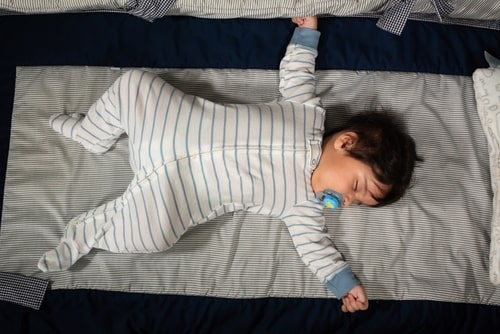
image of baby boy sleeping in cot with arms outstretched by Antonio Tanaka / shutterstock
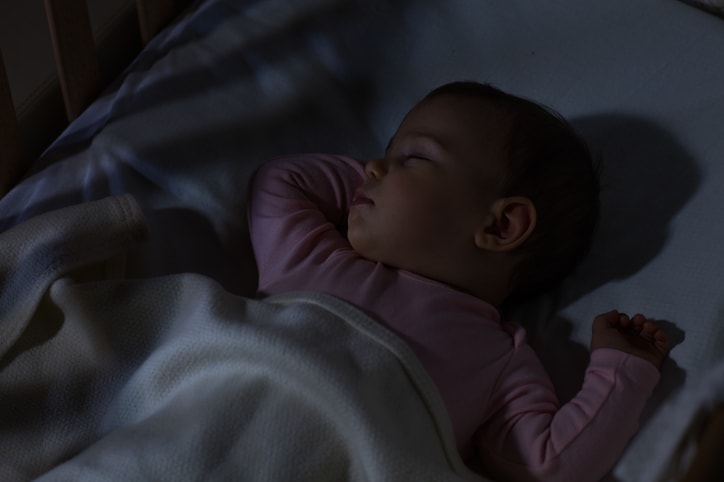
image of sleeping infant in darkness by istock / mdphoto16