Baby sleep habits can be baffling, and they can turn our lives upside down. Whether it’s the crazy-making, nocturnal schedule of the newborn, or an older baby who won’t get settled, the results are the same: A parent who is sleep-deprived and desperate for relief.
What’s a parent to do? Learning about the science of infant sleep can help. Once you understand how, why, and when babies sleep, it will be easier for you to decide on the best sleep strategies for your family. It may also bring you peace of mind.
So check out the weird world of baby sleep patterns, and consider these evidence-based baby sleep tips.
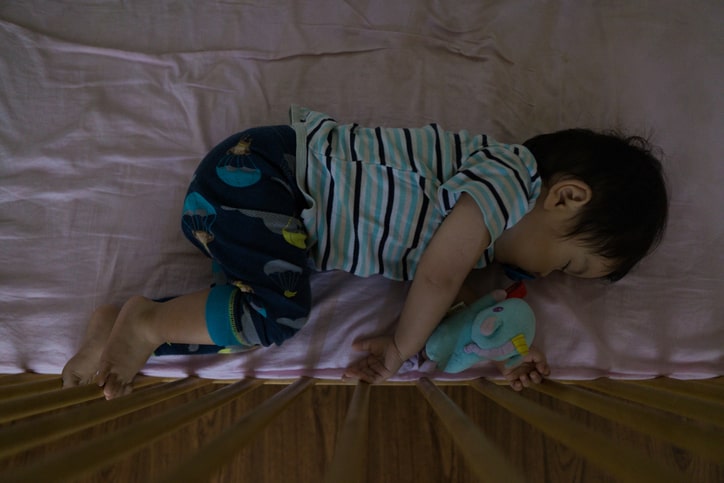
1. New baby? Help program your newborn’s “internal clock” by exposing your baby to strong cues about the external, 24-hour day.
Like us, babies have circadian rhythms, or biological processes that cycle about once every 24-hours.
You can think of these rhythms as an internal clock, but there’s a catch: The clock doesn’t arrive pre-programmed. When babies are born, their internal clocks aren’t synchronized with the external, 24-hour cycle of daylight and darkness. It takes time for babies to get in sync.
Thankfully, we don’t have to wait passively for that to happen. In fact, we shouldn’t be passive. Babies depend on us for help. Studies indicate that babies adapt faster to the 24-hour day when we expose them to natural rhythms of light and darkness, as well as other “zeitgebers,” or environmental cues about the time of day (Custodio et al 2007; Lohr et al 1999; Tsai et al 2012; Wong et al 2022).
In fact, light cues are particularly crucial for setting the “internal clock,” and it appears that babies, even preterm babies, are equipped with a key neural pathway (the retinohypothalamic tract) that helps the brain respond to light signals (Wong et al 2022).
So it’s never too early to expose your baby to natural daylight, and involve your baby in the stimulating hustle and bustle of your daytime activities. When evening falls, protect your baby from exposure to artificial lighting. As I note below (see baby sleep tip #2), such light can delay the onset of sleepiness at night. For more information about coping with newborns, see this Parenting Science article about newborn sleep patterns.
2. When you need artificial lighting at night, use bulbs (or filters) that block blue wavelengths.
If you eliminated all sources of electric and electronic light at night, your baby would probably find it easier to sleep. But for most of us, total blackouts aren’t a realistic option. What can we do when we want to engage in evening activities, like reading? What can we do when we need to change a diaper?
Happily, not all light wavelengths have the same effect on the inner clock. Yes, white light (which is emitted by both fluorescent and incandescent bulbs) has a disruptive effect on sleep patterns, and young children are especially sensitive to the effect.
But it appears that one component of white light — the blue part of the spectrum — is responsible for much of the trouble. If we can block that part of the light spectrum, we might minimize the negative effects of light exposure at night.
A low watt, amber bulb can protect your baby from blue wavelengths, yet provide you with enough light to carry out nighttime infant care. Likewise, blue light filters may reduce the risk to sleep caused by viewing electronic screens at night. Read more in my article about the effects of electronic screens and artificial lighting on children’s sleep patterns.
3. Help your baby get settled: Make the hour leading up to bedtime a time of security, happiness, and emotional reassurance

None of us sleep well when we’re anxious or irritated, and babies are no different. So before bedtime, take steps to ensure that your baby feels safe, secure, happy, and loved. Consider following a bedtime routine (Mindell et al 2015; Mindell et al 2017). Look after your own emotional state, because stress is contagious. Babies become more distressed when their caregivers are distressed (Waters et al 2014; Waters et al 2017). And if you detect negative emotions in your baby, counter them with soothing and reassurance.
Observational studies suggest this emotional support makes a difference. Parents who respond soothingly to their children’s emotions report fewer infant sleep problems, and this is the case regardless of a family’s sleep arrangements. Whether children share a bedroom with their parents, or sleep elsewhere, they sleep better when their parents are sensitive and responsive (Teti et al 2010; Jian and Teti 2016).
4. Learn the art of stress-busting — for your baby and for yourself
It’s hard to soothe a baby who is very irritable or distressed. This Parenting Science article about stress in babies offers insights into what stresses out babies. It also provides evidence-based tips for keeping babies calm and emotionally healthy. But what if you are feeling too stressed-out to project reassurance and calm? Or too depressed?
If so, you aren’t alone. Caring for a baby can be very stressful and exhausting, especially when you are sleep-deprived, coping with childbirth trauma, or struggling with a baby that cries excessively (see baby sleep tip #10).
If you’re emotional state is poor, screen yourself for postpartum depression, and make your psychological health a priority. Postpartum depression and postpartum stress are very common, yet many parents continue to suffer privately. Talk to your doctor about your options. For more information, see my article about the personal costs of parenting stress and these Parenting Science tips for coping.
5. If your baby doesn’t seem to be sleepy at bedtime, don’t try to force it.
Getting pushy doesn’t make babies any sleepier. If anything, it makes them more excitable. And you don’t want your baby to associate bedtime with conflict. That can be a difficult lesson to unlearn! Instead, try the technique known as “positive routines and faded bedtime,” which I describe here.
6. Watch out for those long, late afternoon naps, and try to lengthen the last waking bout before bedtime.

Naps are important for babies. As I explain elsewhere, a well-timed nap helps an infant learn!
But if your baby doesn’t get sleepy until late at night, the first order of business is to make sure your baby isn’t getting exposed to artificial lighting before bedtime (baby sleep tip #2).
The next step? Scrutinize the timing of your baby’s naps. Naps do good things for babies, but babies are like us: Late naps can postpone the drowsiness they would otherwise feel at bedtime (Nakagawa et al 2016).
Then see if you can stretch out the time that your baby spends awake during his or her last active period of the day. When researchers tracked parents who employed this advice, they found that babies began to need less help falling asleep at night (Skulldottir et al 2005).
7. Be mindful of television and other electronic media.
As already noted, nighttime use of electronic screens can cause trouble because they emit sleep-busting, artificial light. But as I explain in this Parenting Science guide, daytime electronic media use might be problematic as well.
Researchers report links between total electronic media use and late bedtimes (Thompson and Christakis 2005). And in one recent study, the effect was strongly dependent on the dose: For every additional 2.5 minutes that babies watched, it took them 5 extra minutes to fall asleep at night (Chonchaiya et al 2017).
8. Not getting enough sleep yourself? Encourage your baby to “tank up” immediately before you fall asleep at night.

Parents lose sleep after the birth of a baby, but one of the biggest problems isn’t the total amount of sleep loss, but the fact that they no longer sleep in longer, more consolidated bouts. As I explain elsewhere, fragmented sleep can be just as bad as insufficient sleep.
So if parents can delay their first night waking — leading to a longer interval of uninterrupted sleep — it could improve their well-being. And an approach called “dream feeding” may help them achieve this. For more information, see my evidence-based overview about dream feeds, which includes tips on implementing the tactic.
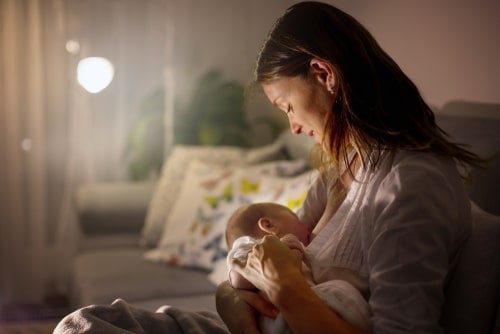
9. Think your baby is waking up? Be cautious about intervening too soon. Your baby might be asleep, or ready to resume sleeping on his or her own.
As I explain in my article about night wakings, it’s normal for sleepers of all ages to experience many partial awakenings at night. When parents report that their infants are “sleeping through the night,” it isn’t that their babies are never waking up. Rather, babies are falling back to sleep, quietly, without signaling their parents.
But young infants sleep very restlessly. They frequently vocalize, and sometimes even open their eyes. So it’s easy for new parents to make the mistake of waking a sleeping infant — or intervene too fast with an infant experiencing momentary wakefulness. And that can interfere with the development of mature sleep patterns, hindering babies from learning to settle themselves.
My Parenting Science articles about baby sleep cycles can help you understand the stages of baby sleep, and become more savvy about how and when to respond. If you give your baby the chance, he or she may learn to self-settle at an earlier age.
10. During middle-of-the-night care, be calm and gentle. But avoid conversation and eye contact.
Nighttime feedings are unavoidable when babies are young. But there are things you can do to make these sessions less disruptive: Be gentle. Be reassuring. And be boring. Very boring.
That last point can be difficult, because you are the single most fascinating thing in your baby’s life. Even something as mundane as quiet talk and eye contact can be very exciting for your baby. Experiments show that babies are especially attuned to — and aroused by — their mothers’ voices (Purhonen et al 2005). In fact, some researchers claim that babies “arouse more easily in response to their mother’s voice than to a smoke alarm” (Grigg-Damberger et al 2007).
Likewise, brain imaging research confirms that eye contact triggers busy activity in an infant’s brain — especially in a part of the brain (the dorsomedial prefrontal cortex) that processes social interactions (Urakawa et al 2015). As I note elsewhere, eye contact seems to send a message to babies. Let’s have a conversation now. It’s party time.
So in addition to keeping things as dark as possible (see baby sleep tip #2), try to avoid conversation and eye contact in the middle of the night. It will make it easier for everyone to fall back to sleep, and it may help your baby develop more mature sleep patterns.
11. If your baby seems to cry inconsolably, don’t blame yourself. Learn about infantile colic, and consult with your pediatrician.
All babies cry, but some babies cry excessively for no apparent reason, and that can make nighttime especially stressful. What’s going on?
Although these babies are often diagnosed as “colicky,” that term is little more than a label for “we don’t know why your baby cries so much.” To figure out what might be bothering your baby, see my overview about the possible causes of infantile colic, and discuss your concerns with your pediatrician.
12. White noise? Swaddling? Bed sharing? Be mindful of safety.
There is an entire industry devoted to helping babies sleep. But are all infant sleep aids equally effective? Clearly not. In fact, some practices can even be harmful.
For example, there is reason to think that white noise can help babies sleep. But researchers have found that many sound machines sold for this purpose can produce noise at volumes that could harm an infant’s ears. Likewise, the traditional practice of swaddling might help babies sleep longer, but certain kinds of tight swaddling can put your baby at risk for health problems.
For more information, see these evidence-based baby sleep tips about sleep aids — what works, what doesn’t work, and what poses a hazard. The article includes evidence-based discussions of bedtime routines, infant massage, pacifiers, rocking, lavender, and other potential sleep aids.
What about bed-sharing? If you are considering it, learn about the potential hazards. Throughout human history, in cultures throughout the world, mothers have lain alongside their infants. But people in these cultures were sleeping on very firm surfaces — like mats on a hard floor — and they didn’t expose their infants to soft bedding, which can cause terrible suffocation accidents, and increase the risk of SIDS, or sudden infant death syndrome.
Studies of Western SIDS cases suggest that babies — especially very young babies — are at high risk if they sleep in a Western-style bed. For information about minimizing the risk of SIDS, see these basic safety guidelines.
13. Don’t feel pressured to burp or diaper your baby if doing so will wake your baby up.
When your baby is sleeping — or about to doze off — the last thing you want to do is jolt her awake with intrusive care-giving. So can you wait? That seems likely.
In a recent study of more than 70 infants, researchers found no evidence that burping was beneficial to babies. It didn’t make them cry less, and it actually increased a baby’s chances of regurgitating after a meal (Kaur et al 2015). And an earlier experiment suggests that babies aren’t awakened by the sensation of a wet diaper (Zotter et al 2007).
14. Get realistic expectations about your baby’s sleep habits.
What’s the right bed time? How long should your baby sleep? When should your baby begin sleeping for long intervals at night? If you knew the answers to these questions, it would help you avoid pitfalls — and needless frustration.
For example, when your baby isn’t sleeping the way you’d expect, it’s easy to assume that you’re doing something wrong. New parents sometimes worry that there is something developmentally awry if their young infants are waking up multiple times at night. In fact, night wakings are perfectly normal.
Parents can also make the mistake of setting the wrong bedtimes, and try to force their babies to fall asleep at a time that’s out of sync with their internal clock. As noted in baby sleep tip #4, the resulting conflict can create lasting sleep problems.
And sometimes parents are overly complacent about certain things — like a baby’s vampire-like, nocturnal schedule. If you assume this is something you can’t change, it can become a self-fulfilling prophesy. You might not employ important strategies, like the baby sleep tips about light cues.
So it helps to learn about normal course of infant sleep development, and the wide range of variation that healthy babies can show. For baby sleep tips about what’s typical, see this baby sleep chart, as well as these Parenting Science pages:
- Baby sleep patterns
- Baby sleep requirements
- Signs of sleep deprivation in babies
- Night wakings: A guide for the science-minded
15. Struggling with baby sleep problems? Troubleshoot with the help of these guidelines
This Parenting Science article reviews the most common problems, and offers baby sleep tips for solving them. In addition, if you suspect your baby’s problems are caused by a medical condition, talk to your pediatrician about your concerns, and read my overview ailments that can interfere with infant sleep.
References: Baby sleep tips
Chonchaiya W, Wilaisakditipakorn T, Vijakkhana N, Pruksananonda C. 2017. Background media exposure prolongs nighttime sleep latency in Thai infants. Pediatr Res. 81(2):322-328.
Custodio RJ, Junior CE, Milani SL, Simões AL, de Castro M, Moreira AC. 2007. The emergence of the cortisol circadian rhythm in monozygotic and dizygotic twin infants: the twin-pair synchrony. Clin Endocrinol (Oxf). 66(2):192-7.
Galland BC, Taylor BJ, elder DE, and Herbison P. 2012. Normal sleep patterns in infants and children: A systematic review of observational studies. Sleep Medicine Reviews 16: 213-222.
Jian N and Teti DM. 2016. Emotional availability at bedtime, infant temperament, and infant sleep development from one to six months. Sleep Med. 23:49-58.
Kaur R, Bharti B, Saini SK. 2015. A randomized controlled trial of burping for the prevention of colic and regurgitation in healthy infants. Child Care Health Dev. 41(1):52-6.
Lohr B, Siegmund R. 1999. Ultradian and circadian rhythms of sleep-wake and food-intake behavior during early infancy. Chonobiology international 16(2): 129-148.
Nakagawa M, Ohta H, Nagaoki Y, Shimabukuro R, Asaka Y, Takahashi N, Nakazawa T, Kaneshi Y, Morioka K, Oishi Y, Azami Y, Ikeuchi M, Takahashi M, Hirata M, Ozawa M, Cho K, Kusakawa I, Yoda H. 2016. Daytime nap controls toddlers’ nighttime sleep. Sci Rep. 6:27246.
Mindell JA, Leichman ES, Lee C, Williamson AA, Walters RM. 2017. Implementation of a nightly bedtime routine: How quickly do things improve? Infant Behav Dev. 49:220-227.
Mindell JA, Li AM, Sadeh A, Kwon R, and Goh DY. 2015. Bedtime routines for young children: a dose-dependent association with sleep outcomes. Sleep 38(5): 717-722.
Purhonen M, Kilpeläinen-Lees R, Valkonen-Korhonen M, Karhu J, Lehtonen J. 2005. Four-month-old infants process own mother’s voice faster than unfamiliar voices–electrical signs of sensitization in infant brain. Brain Res Cogn Brain Res. 24(3):627-33.
Skuladottir A, Thome M, Ramel A. 2005. Improving day and night sleep problems in infants by changing day time sleep rhythm: a single group before and after study. Int J Nurs Stud. 42(8):843-50.
Teti DM, Kim BR, Mayer G, Countermine M. 2010. Maternal emotional availability at bedtime predicts infant sleep quality. J Fam Psychol. 24(3):307-15
Thompson DA, Christakis DA. The association between television viewing and irregular sleep schedules among children less than 3 y of age. Pediatrics 2005;116:851–6.
Tsai SY, Thomas KA, Lentz MJ, Barnard KE.2012. Light is beneficial for infant circadian entrainment: an actigraphic study. J Adv Nurs. 68(8):1738-47.
Urakawa S, Takamoto K, Ishikawa A, Ono T, Nishijo H. 2015. Selective Medial Prefrontal Cortex Responses During Live Mutual Gaze Interactions in Human Infants: An fNIRS Study. Brain Topogr. 28(5):691-701.
Waters SF, West TV, Karnilowicz HR, Mendes WB. 2017. Affect contagion between mothers and infants: Examining valence and touch. J Exp Psychol Gen. 146(7):1043-1051.
Waters SF, West TV, Mendes WB. 2014. Stress contagion: physiological covariation between mothers and infants. Psychol Sci. 25(4):934-42.
Wong SD, Wright KP Jr, Spencer RL, Vetter C, Hicks LM, Jenni OG, LeBourgeois MK. 2022. Development of the circadian system in early life: maternal and environmental factors. J Physiol Anthropol.16;41(1):22.
Wooding AR, Boyd J, and Geddis DP. 1990. Sleep patterns of New Zealand infants during the first 12 months of life. Journal of Pediatrics and Child Health 26: 85-88.
Zotter H, Urlesberger B, Pichler G, Mueller W, Kerbl R. 2007. Do wet diapers induce arousals in sleeping infants? Acta Paediatr. 96(3):452-3.
Content of “Baby sleep tips” last modified 10/2024
Portions of text derive from earlier versions of this article by the same author.
image of baby sleeping in crib by nanausop / istock
image of mother reading to infant by HarryKiiM Stock / istock
image of infant napping and mother watching by :Prostock-Studio / istock
Image of tired mother bottlefeeding infant by Chanintorn.v / shutterstock