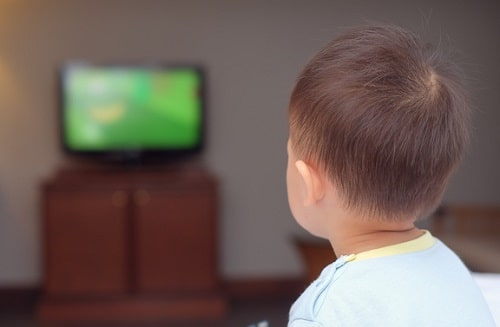
Studies report a link between TV and language development in young children. The more time kids spend watching television, the more slowly they learn to talk. What’s going on?
Some people conclude that the effects of television on children are direct and negative. According to this view, television is noxious, like cigarette smoke. Cigarettes damage the lungs. Television damages the mind. But correlation isn’t causation, and a more fine-grained analysis of the problem supports a very different conclusion:
TV is linked with slower language acquisition because TV time tends to displace conversation time between babies and adults.
What the data really show
To date, we lack strong evidence that watching television — in moderation — leads to long-term deficits in cognitive development (Vedechkina and Borgonovi 2021). That doesn’t mean there aren’t any worries, or reasons for concern.
It’s clear that inappropriate content can be upsetting. When children watch television that is violent or disturbing, they may feel threatened. This could lead to emotional distress and behavior problems (e.g., Fitzpatrick et al 2012). In addition, television has the potential to disrupt sleep, and disrupted sleep can interfere with a child’s ability to concentrate and learn.
(You can read more about the effects of television on sleep in this Parenting Science article.)
Researchers have also proposed that certain types of content might interfere with the development of attention skills.
For example, in one study, Frederick Zimmerman and Dmitri Christakis tracked toddlers over time, and looked for links between early television viewing habits (before age 3) and later attention problems. The researchers found no attention problems associated with watching high-quality, age-appropriate educational content. But the situation was different for violent content, and for non-educational entertainment. If kids were in the habit of watching violent or non-educational television programs before the age of 3, they were more likely to experience attention problems at the age of 4 or 5 (Zimmerman and Christakis 2007).
Why? Some researchers speculate that the trouble is caused by rapid pacing and abrupt edits. But the evidence is mixed (e.g., Cooper et al 2009). We need more studies to figure this out.
Another important concern is background television — what children experience when they are playing or learning in a room where a television is switched on.
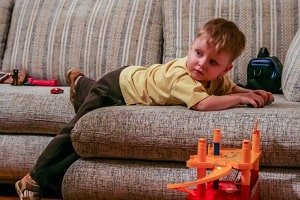
As you might expect, background television can be distracting. In one experiment, children’s play becomes less focused when a television was on in the background (Schmidt et al 2012).
In addition, there are hints that regular exposure to background television could lead to the development of attention problems (e.g., Gueron-Sela and Gordon-Hacker 2020; Ribner et al 2020). And background television can expose children to distressing content. So psychologists warn parents against watching violent or otherwise inappropriate content while their young children are present.
Finally, there’s reason to think that television viewing could pose problems for learning language, but not because television is intrinsically harmful.
On the contrary, sometimes television can be helpful. For instance, in a study tracking children from the age of 6 months, researchers discovered a positive link between vocabulary growth and watching certain educational programs. Compared with children who didn’t watch any television, children who watched Arthur, Clifford, Blue’s Clues, Dragon Tales, or Dora the Explorer actually acquired more vocabulary by the age of 30 months (Linebarger and Walker 2005).
And overall? What’s the trend across studies? When researchers reviewed 76 published studies, they found evidence that preschoolers may actually benefit from watching high-quality, educational preschool television (Kostyrka-Allchorne et al 2017).
So what makes television problematic for children learning to talk?
Based on what researchers have learned so far, it’s most likely a question of missed opportunities.
Babies and toddlers learn language most readily when we engage them in one-on-one conversation. So if young children spend lots of time watching TV — and thereby lose opportunities to engage in conversation — they are at a disadvantage.
To see what I mean, consider this evidence.
When it comes to learning speech, nothing beats a live conversation

Patricia Kuhl, a leading researcher in the field of language acquisition, has demonstrated this point in some elegant experiments on babies.
Kuhl and her colleagues presented 9-month old American babies with an unfamiliar language—Mandarin Chinese. In one experiment, babies were allowed to interact with a real, live Mandarin speaker. After 12 sessions, these babies showed an enhanced ability to discriminate certain speech sounds that are common in the Mandarin language.
But when the experiment was repeated with another set of infants who watched only televised language tutors, the results were different. The babies exposed to Mandarin via TV were no more likely than control infants to discriminate Mandarin speech sounds (Kuhl et al 2003).
In both experiments, the Mandarin speakers gazed directly at the babies, discussed toys, and used that special, “baby-friendly” style of speaking known as “infant-directed speech.”
The difference between experiments was the social factor. As Kuhl notes, “infants are apparently not computational automatons—rather, they might need a social tutor when learning a natural language” (Kuhl 2004).
Research suggests that conversation, not listening to stories or watching TV, has the strongest positive effect on early language development

This idea is supported by a study that fitted young children, aged zero to four years, with recording devices (Christakis et al 2009).
The devices allowed researchers to objectively measure how much adult conversation and television each child experienced. And the results were intriguing.
Researchers discovered that social talk — one-on-one, back-and-forth conversation between adults and their children — was linked with better language development. The more time babies and toddlers were included in adult conversations, the more quickly their language skills improved.
By contrast, listening to adult monologues — including storytelling — was only weakly correlated with language development. The effect of two-way conversations was almost 6 times greater than the effect of merely listening to adults talk.
And TV? When researchers controlled for the amount of time that kids spent in conversation, the effect of television on children was neither positive nor negative.
It’s a single study, but subsequent research bolsters the idea that one-on-one conversation is the most powerful way for young children to learn.
The more time kids spend in conversation with adults, the more likely they are to develop large vocabularies. Merely overhearing adults talk? Kids sometimes learn that way (Fitch et al 2020). But overall, children can learn much more from participating in conversation than they can from listening on the sidelines (Shneidman and Goldin-Meadow 2012; Shneidman et al 2013; Weisleder and Fernald 2013).
What about other screen-based experiences, like video chat technology? Can young children learn language by talking with someone via video chat?
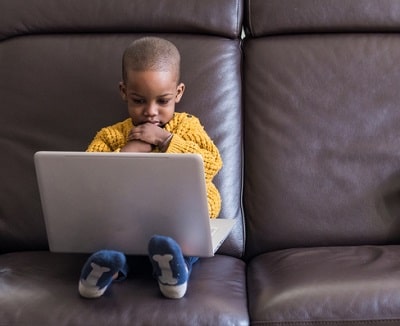
Maybe. But, if so, it probably depends on the child’s understanding of how video chats different from traditional, passive television-watching. Kids need to see that they’re involved a real, interactive conversation.
To see what I mean, consider an experimental study conducted by Sarah Roseberry and her colleagues (Roseberry 2014). The researchers randomly assigned a group of toddlers (24-30 months) to experience one of two types of adult conversation:
- an adult talking to them live, via Skype; or
- an adult who appeared to be communicating via Skype but who was actually pre-recorded.
Under both conditions, toddlers attempted to communicate with the adult, but only the “live” adult responded appropriately to the children’s comments, questions, or facial expressions.
The pre-recorded adults talked in the manner of a television talk show host – appearing to engage the audience, but obviously unable to react contingently to anything the kids did or said.
After these sessions, the toddlers were tested to see if they’d learned unfamiliar words that the adult had used. And the outcome? Only the kids who’d engaged in real, live conversations picked up the new vocabulary.
The findings are supported by a more recent study, where researchers performed a similar test on even younger children (12-25 months). Babies who participated in interactive, online chats learned from the experience (Myers et al 2017).
So yes — young children can learn from video chats. But it may depend on children feeling a personal connection.
In both of the video chat studies, kids didn’t simply start watching a stranger on a screen. Video chats began with a warm-up period, during which adult greeted them by name, and asked them to respond to questions about their recent activities (e.g., “Did you like playing with the blocks?”).
These preliminaries may have helped the children realize that they were being addressed by a live human being. And that could be crucial. When researchers have tried testing children without taking these steps, young children have failed to learn from live video chatting (Troseth et al 2018; Strouse et al 2018).
So what’s the takeaway?
It appears that certain types of screen content — violent, age-inappropriate content — can trigger distress and (possibly) contribute to attention problems. In addition, television can disrupt sleep. And background TV may distract a child’s focus.
Because of these factors — and because the evidence is at best inconclusive about possible benefits for infant viewers — the American Academy of Child and Adolescent Psychiatry recommends that we limit screen use to “video chatting along with an adult” for children under the age of 18.” For kids between 2 and 5 years, this organization recommends that that parents “limit non-educational screen time to about 1 hour per weekday and 3 hours on the weekend days” (American Academy of Child and Adolescent Psychiatry 2020).
But when it comes to learning to talk, the most important takeaway concerns the effects of live conversations between children and adults.
It isn’t so much that language delays are caused by watching television. It’s that children benefit most when they engage in conversations with other people. Screen time can create problems if it displaces conversation time and other important, real-world, developmental activities. Our best bet? Give our kids lots of opportunities to discuss, explore, ask questions, and respond.
Helping babies learn language: More tips
Learn more about your baby’s developing language skills from these Parenting Science articles:
- Baby talk 101: How infant-directed speech helps babies learn language
- When do babies speak their first words?
- Talking to babies: How eye contact helps babies tune in
- Baby sign language: A guide for the science-minded parent
- Can babies sign before they speak?
And if you’re wondering what your baby might be thinking when he or she watches TV, check out these articles about the way infants react to the social interactions of others:
- Moral sense: Do babies know right from wrong?
- Babies expect fairness, and prefer people who behave with fairness
- Do babies feel empathy?
References: The effects of television on children who are learning to talk
American Academy of Child and Adolescent Psychiatry. 2020. “Screen Time and Children.” https://www.aacap.org/AACAP/Families_and_Youth/Facts_for_Families/FFF-Guide/Children-And-Watching-TV-054.aspx. Accessed 18 Aug 2023.
Cooper NR, Uller C, Pettifer J, and Stolc FC. 2009. Conditioning attentional skills: examining the effects of the pace of television editing on children’s attention. Acta Paediatr. 2009 Jun 4. [Epub ahead of print].
Christakis DA, Gilkerson J, Richards JA, Zimmerman FJ, Garrison MM, Xu D, Gray S, and Yapanel U. 2009. Audible Television and Decreased Adult Words, Infant Vocalizations, and Conversational Turns: A Population-Based Study. Arch Pediatr Adolesc Med. 163(6):554-558.
Crawley AM, Anderson DR, Wilder A, Williams M, and Santomero A. 1999. Effects of repeated exposures to a single episode of the television program Blue’s Clues on the viewing behaviors and comprehension of preschool children. J Educ Psychol. 91: 630-638.
Fitzpatrick C, Barnett T, Pagani LS. 2012. Early exposure to media violence and later child adjustment. J Dev Behav Pediatr. 33(4):291-7
Geist EA, Gibson M. 2000. The effect of network and public education television programs on four and five year olds ability to attend to educational tasks. J Instructional Psychol. 27:250-261.
Gueron-Sela N and Gordon-Hacker A. 2020. Longitudinal Links Between Media Use and Focused Attention Through Toddlerhood: A Cumulative Risk Approach. Front Psychol. 11:569222.
Hirsh-Pasek K, Adamson LB, Bakeman R, Owen MT, Golinkoff RM, Pace A, Yust PK, Suma K. 2015. The Contribution of Early Communication Quality to Low-Income Children’s Language Success. Psychol Sci. 26(7):1071-83.
Kostyrka-Allchorne K, Cooper NR, and Simpson A. 2017. The relationship between television exposure and children’s cognition and behaviour: a systematic review. Dev. Rev. 44: 19–58.
Kuhl PK. 2004. Early language acquisition: Cracking the speech code. Nature Neuroscience 5: 831-843.
Kuhl PK, Tsao FM, and Liu HM. 2003. Foreign-language experience in infancy: effects of short-term exposure and social interaction on phonetic learning. Proc Natl Acad Sci U S A. 100(15):9096-101.
Lillard AS and Peterson J. 2011. The immediate impact of different types of television on young children’s executive function. Pediatrics 128: 644–649.
Linebarger DL and Walker D. 2005. Infants’ and toddlers’ television viewing and language outcomes. Am. Behav. Sci. 48 624–645.
Myers LJ, LeWitt RB, Gallo RE, Maselli NM. 2017. Baby FaceTime: can toddlers learn from online video chat? Dev Sci. 20(4).
Nathanson AI, Aladé F, Sharp ML, Rasmussen EE, Christy K. 2014. The relation between television exposure and executive function among preschoolers. Dev. Psychol. 50: 1497–1506.
Ribner AD, Barr RF, Nichols DL. Pediatr Res. 2020. Background media use is negatively related to language and literacy skills: indirect effects of self-regulation. 2020 Jun 10. doi: 10.1038/s41390-020-1004-5. Online ahead of print.
Roseberry S, Hirsh-Pasek K, and Golinkoff R. 2014. Skype Me! Socially Contingent Interactions Help Toddlers Learn Language. Child Dev. 85(3): 956–970.
Schmidt ME, Pempek TA, Kirkorian HL, Lund AF, Anderson DR. 2008. The effects of background television on the toy play behavior of very young children. Child Dev 79(4):1137-51.
Shneidman LA, Goldin-Meadow S. 2012. Language input and acquisition in a Mayan village: how important is directed speech? Dev Sci. 15(5):659-73.
Shneidman LA, Arroyo ME, Levine SC, and Goldin-Meadow S. 2013. What counts as effective input for word learning? J Child Lang. 40(3):672-86.
Troseth GL, Strouse GA, Verdine BN, Saylor MM. 2018. Let’s Chat: On-Screen Social Responsiveness Is Not Sufficient to Support Toddlers’ Word Learning From Video. Front Psychol. 9:2195.
Vedechkina M and Borgonovi F. 2021. A Review of Evidence on the Role of Digital Technology in Shaping Attention and Cognitive Control in Children. Front Psychol. 12:611155.
Weisleder A and Fernald A. 2013. Talking to children matters: early language experience strengthens processing and builds vocabulary. Psychol Sci. 24(11):2143-52.
Content last modified 5/21
Some of the text in this article appeared in an earlier version of the article by the same author.
Image credits for “Effects of television on children learning to talk”
title image of child watching TV by Yaoinlove / istock
image of boy lying on couch, distracted by dmakig /istock
image of mother talking face-to-face with baby by fizkes /istock
image of father and infant in supermarket by Yaoinlove / shutterstock
image of little boy sitting on couch looking at laptop by Eugenio Marongiu / shutterstock