We often hear claims that video games can have bad effects on a player’s well-being, particularly if gaming becomes excessive or compulsive. But video games have also been linked with positive effects, including enhanced visual attention skills. And some folks have wondered: Is it possible that certain games could foster “prosocial” behavior — such as the tendency to cooperate, sympathize, or offer help? Can video games improve social skills? There is reason to think so.
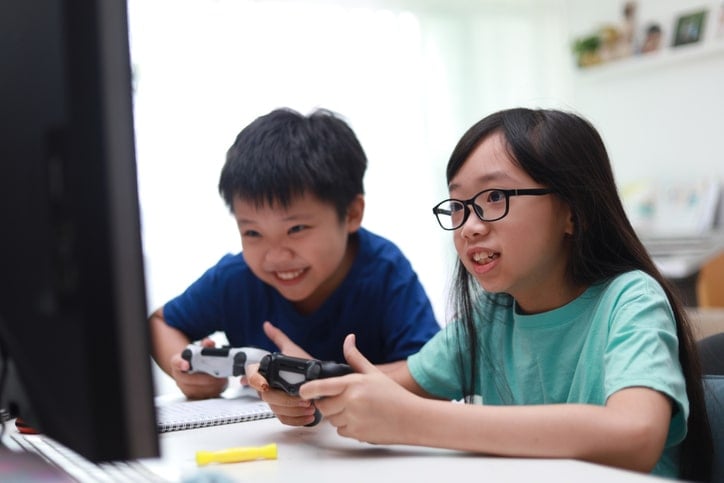
First, consider the circumstantial evidence. When researchers ask players about their gaming habits, they usually find the same pattern: Individuals who spend more time playing prosocial video games tend to engage in more prosocial behavior in their everyday lives (Greitemeyer 2022; Greitemeyer and Mügge 2014).
For example, back in 2009, Douglas Gentile and his colleagues surveyed 727 middle school students from Singapore. They asked these adolescents to
- name their three favorite video games,
- estimate how much time they spent playing each game, and
- rate how often players help—or hurt—each other in the games.
In addition, they asked kids whether or not they agreed with a series of personal statements about social behavior (like: “I feel happy when I share my things with others” and “In general, it is OK to hit other people”). They also presented kids with a series of hypothetical scenarios, and asked them to interpret the intentions of the characters depicted.
What happened? Individuals who spent more time playing prosocial video games were more likely to say that they engaged in prosocial behaviors in their everyday lives. And these kids were less likely to attribute hostile intentions to other people.
In a second study, Gentile’s team surveyed more than 1800 kids in Japan – students in the 5th, 8th, and 11th grades. They asked kids how much time they spent playing prosocial video games, and then, 3 to 4 months later, they questioned these same kids about their social habits. Once again, playing prosocial video games was linked with being nice in real life.
Results like these suggest that prosocial games might cause beneficial change. But without careful experimentation, it’s impossible to pinpoint causation. Maybe it’s merely a case of kids choosing to play prosocial games because they are already inclined to engage in friendly, cooperative behavior. So what do experiments tell us?
Experimental evidence that we can foster prosocial behavior through gaming
Suppose you had a group of volunteers, and you randomly assigned some of them to play a prosocial video game. Others would play a violent video game – or a socially neutral one.
After a predetermined amount of game time, you put your players to the test — giving them the opportunity to help somebody in real life. Do people respond differently depending on their recent gaming experiences? Are prosocial gamers more likely to become helpers? If so, you have experimental evidence that video games can improve social behavior. At least temporarily.
Douglas Gentile and his colleagues tried this approach on college students, and the results were consistent with the idea that playing nice leads to acting nice. Those who had been assigned to play a prosocial game (Super Mario Sunshine or Chibi Robo) ended up acting more charitably towards others in a subsequent task (Gentile et al 2009).
Might the same be true for children? There’s reason to think so. In 2012, Muniba Saleem led a similar experiment on kids between the ages of 9 and 14, and, once again, researchers found evidence for a prosocial boost. More recently, Anat Shoshani and her colleagues presented young children, aged 3 to 6, with a variety of touch-screen, tablet-based games. Compared with kids assigned to play violent or socially neutral games, kids who were randomly assigned to play prosocial games went on to show “higher levels of helping behavior” towards an adult afterwards (Shoshani et al 2021).
What about reading the emotions of others? Can video games help kids improve their ability to empathize?
Maybe, but we don’t yet know. A few years back, Tammi Kral and her colleagues tested a lab-designed video game, one that required players to read the facial expressions of different characters. The researchers wanted to know if gameplay could improve a youngster’s empathic skills, so they randomly assigned kids (aged 11-14 years) to play either this “empathy” game or another, similar game that lacked the face-reading component.
After two weeks, the researchers looked for signs that kids in the “empathy” gaming group were better at interpreting emotions. They couldn’t find any. But brain scans revealed a difference: Kids in the “empathy video game” condition experienced greater connectivity in empathy-related circuits of the brain (Kral et al 2018). It’s interesting, but not enough for us to conclude that video games can teach empathy.
Can video games improve social skills in children on the autism spectrum?
Once again, the evidence is limited, but there are hints. In a study of 70 children on the autism spectrum (ranging in age from 7 to 12), half the kids were randomly assigned to play “Secret Agent Society”, a computer game designed to teach a variety of social skills, including the reading of emotions and the ability to initiate and carry on a conversation. The rest of the kids were assigned to a control group. They played video games designed to foster improvement in several academic subject areas, such as geography and history.
It’s unclear how much time children spent playing these video games, but they played on multiple occasions over a period of 10 weeks. And at the end of this period, researchers asked parents to rate their children’s social skills. The results? Kids assigned to play the social skills video game showed greater improvements, as measured by parental reports (Beamont et al 2021).
It isn’t super-compelling evidence, because the parents in this study were aware that their kids were supposed to be honing their social skills. This might have biased their evaluations. Moreover, parents were encouraged to “help children apply the skills that were introduced in the (Secret Agent Society) computer game in daily life.” So kids did more than play video games. We don’t know how much of the observed effect was attributable to the game, and how much was attributable to those family practice sessions.
What’s the takeaway?
We have multiple lines of evidence suggesting (1) that prosocial play goes along with prosocial behavior in real life, and (2) that playing prosocial video games may put adults and children alike into a friendlier mode – a state of mind that makes us more likely to behave in helpful or kind ways.
It’s not clear how long the effect lasts. Perhaps it lasts for only a brief time immediately after play. But even if that is the case – even if the feeling wears off after 20 minutes – there’s still the potential for lasting benefits. Whenever a child has a positive, prosocial encounter with another person, it’s an opportunity for that child to learn about the benefits of being kind, supportive, or cooperative. It’s emotionally rewarding, and helps kids feel more connected to others. So if playing prosocial games increases these opportunities, that’s a good thing. It might give kids a little boost in the direction of developing better social skills.
Can gaming boost empathy? Can video games improve social skills in kids on the autistic spectrum? It seems plausible that specially-designed video games could have these effects. But for now, the evidence is merely suggestive. We need more research to answer these questions.
More reading fostering prosocial behavior and empathy
For information about the development of prosocial behavior, see this Parenting Science article on the perils of rewarding kids for being helpful, and my research-based tips for fostering empathy in children.
References: The beneficial social effects of video games
Beaumont R, Walker H, Weiss J, Sofronoff K. 2021. Randomized Controlled Trial of a Video Gaming-Based Social Skills Program for Children on the Autism Spectrum. J Autism Dev Disord. 51(10):3637-3650.
Gentile DA, Anderson CA, Yukawa S, Ihori N, Saleem M, et al. 2009. The effects of prosocial video games on prosocial behaviors: International evidence from correlational, longitudinal, and experimental studies. Pers. Soc. Psychol. Bull. 35(6): 752-763.
Greitemeyer T. 2022. The dark and bright side of video game consumption: Effects of violent and prosocial video games. Curr Opin Psychol. 46:101326.
Greitemeyer T and Mügge DO. 2014. Video Games Do Affect Social Outcomes: A Meta-Analytic Review of the Effects of Violent and Prosocial Video Game Play. Pers Soc Psychol Bull. 240(5):578-89.
Kral TRA, Stodola DE, Birn RM, Mumford JA, Solis E, Flook L, Patsenko EG, Anderson CG, Steinkuehler C, Davidson RJ. 2018. Neural correlates of video game empathy training in adolescents: a randomized trial. NPJ Sci Learn. 3:13.
Prot S, Gentile DA, Anderson CA, Suzuki K, Swing E, Lim KM, Horiuchi Y, Jelic M, Krahé B, Liuqing W, Liau AK, Khoo A, Petrescu PD, Sakamoto A, Tajima S, Toma RA, Warburton W, Zhang X, and Lam BC. 2013. Long-term relations among prosocial-media use, empathy, and prosocial behavior. Psychol Sci. 25(2):358-68.
Saleem M, Anderson CA and Gentile DA 2012. Effects of prosocial, neutral, and violent video games on children’s helpful and hurtful behaviors. Aggressive Behavior 38: 281-287.
Shoshani A, Nelke S, and Girtler I. 2021. Tablet applications as socializing platforms: the effects of prosocial touch screen applications on young children’s prosocial behavior. Computers in Human Behavior 127(3):107077.
Written content last modified 7/22
Portions of this text derive from earlier versions of this article written by the same author
image of kids playing video game at desk by istock / tylim