What causes postpartum stress in new mothers? It’s clear that childbirth is stressful. During labor, the hormones associated with psychological stress — epinephrine and cortisol — rise by a whopping 500% (Alehagen et al 2001). And in the aftermath, mothers may experience a number of physical stressors, like perineal pain, torn tissues, backaches, and urinary tract problems.
But for many parents, the most troublesome stress is psychological (Ayers et al 2019; Walker et al 2022). Parents may find themselves plagued by
- poor sleep;
- fears and anxieties about the baby’s health;
- worries about the post-pregnancy body and sexuality;
- insensitive treatment by health care professionals;
- disappointment about the quality of support received from one’s partner;
- feelings of isolation or loneliness;
- guilt over having negative thoughts about the baby or parenthood; and
- financial worries or pressures related to returning to the workplace.
Parents may also suffer from the “baby blues,” postpartum depression, or postpartum obsessive-compulsive disorder.
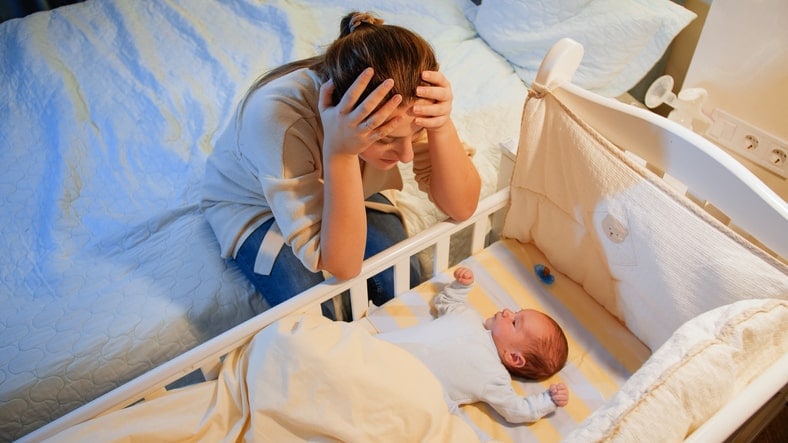
The “baby blues,” characterized by feelings of sadness, anxiety, and mood swings, is the most common condition, estimated to affect 33%-80% of all postpartum mothers (Hopkins et al 1984; Faisal-Cury et al 2008;Hau and Levy 2003; Adewuya 2005; Reck et al 2015). Symptoms typically begin within the first 10 days postpartum (O’Hara 1995) and may be triggered by the sudden reduction of progesterone levels after childbirth (Harris 1996).
Postpartum depression is also quite prevalent, affecting up to 25% of new mothers (Gelaye et al 2016). Postpartum obsessive-compulsive disorder may affect 10% of women during the first two weeks after childbirth. What makes postpartum stress so intense, and what can we do to cope with it?
Get social support
It’s the same story across the world, from Australia to Nigeria, from South Korea to the United States: Women lacking high levels of social support are more likely to experience postpartum depression and anxiety (Inekwe and Lee 2022; Adeyemo et al 2020; Cho et al 2022; Schwab-Reese et al 2017). Researchers have found that mothers could improve their symptoms of postpartum depression by participating in peer support groups (e.g., Gillis and Parish 2019; Shorey et al 2019). So if you don’t have friends and family to help, see if you can connect with other new parents.
Get sleep
Sleep loss contributes to stress in a variety of ways. It’s harder to concentrate and think, which makes everything more difficult. Indeed, as I explain elsewhere, parents tend to feel their lives are more stressful the day after a poor night’s sleep. Sleep loss can also make us feel more moody and aggressive (Demichelis et al 2021). And the weird timing of newborn sleeping schedules can disrupt our internal clocks, putting us at risk for developing a mood disorder. Studies suggests that baby “jet lag” can cause insomnia and contribute to postpartum depression (Flora 2005; Gallaher et al 2018). Learn more information about newborn sleep–including tips that may help reduce postpartum stress — in this article on newborn sleep patterns.
Abandon unrealistic expectations
New mothers may hold themselves to unrealistic standards, expecting to feel only happiness and selfless, nurturing love after the birth of a child. When the postpartum experience doesn’t measure up to these expectations, mothers may feel inadequate, disappointed, and let down (Pancer et al 2000).
If you are the victim of unrealistic expectations, take a reality check. Newborn care is often exhausting, stressful, dirty work. And research suggests that negative thoughts and emotions are a normal part of the postpartum period (Hall and Wittkowski 2006; Graham et al 2002).
Understand that childbirth stress can have lingering effects
Women who receive little social support during childbirth have more difficulty postpartum, even weeks later. Read more about it in my article about childbirth trauma.
Recognize that some newborns are more difficult to care for
Newborns have individual temperaments. Some are relatively easy going. They’re good sleepers and relatively easy to soothe. Some are very fussy or “high need” babies who need constant attention. And some suffer from colic — bouts of excessive, inconsolable crying.
Clearly, babies who are “high need” and/or colicky are more work. You’re going to have a tougher time if your infant cries persistently despite your best attempts to feed, soothe, and hold him or her. But learning more about persistent crying may help you cope. See my article, “Infant crying, fussing, and colic: An anthropological perspective on the role of parenting.”
More information from Parenting Science about stress and how to cope
As I explain elsewhere, stress can be contagious. When parents are stressed-out, it can spread to the kids. And yes, even babies can sense when we’re stressed. Learn more about stress from these Parenting Science pages:
- Family stress: An evidence-based guide
- Parenting stress: What causes it, and how does it change us?
- Parenting stress: 12 evidence-based tips for making life better
- Can babies sense stress in others? Yes they can!
- Stress in babies: How to keep babies calm, happy, and emotionally healthy
- Secure attachment relationships protect kids from toxic stress
References
Adeyemo EO, Oluwole EO, Kanma-Okafor OJ, Izuka OM, Odeyemi KA. 2020. Prevalence and predictors of postpartum depression among postnatal women in Lagos, Nigeria. Afr Health Sci. 20(4):1943-1954.
Alehagen S, Wijma K, Lundberg U, Melin B, and Wijma B. 2001. Catecholamine and cortisol reaction to childbirth. International journal of behavioral medicine, 8(1): 50-65.
Ayers S, Crawley R, Webb R, Button S, Thornton A; HABiT collaborative group. 2019. What are women stressed about after birth? Birth. 46(4):678-685.
Beck CT, Gable RK, Sakala C, and Declercq ER. 2011. Posttraumatic stress disorder in new mothers: results from a two-stage U.S. national survey. Birth. 2011 Sep;38(3):216-27.
Cho H, Lee K, Choi E, Cho HN, Park B, Suh M, Rhee Y, Choi KS. 2022. Association between social support and postpartum depression. Sci Rep. 12(1):3128.
Demichelis OP, Grainger SA, McKay KT, Bourdaniotis XE, Churchill EG, Henry JD. 2022. Sleep, Stress and Aggression: Meta-Analyses Investigating Associations and Causality. Neurosci Biobehav Rev:104732.
Flora, C. 2005. An ordinary trigger for the baby blues. Psychology Today 38(2): 21.
Gallaher KGH, Slyepchenko A, Frey BN, Urstad K, Dørheim SK. 2018. The Role of Circadian Rhythms in Postpartum Sleep and Mood. Sleep Med Clin. 13(3):359-374.
Gelaye B, Rondon MB, Araya R, Williams MA. 2016. Epidemiology of maternal depression, risk factors, and child outcomes in low-income and middle-income countries. Lancet Psychiatry. 3(10):973-982.
Gillis BD and Parish AL. 2019. Group-based interventions for postpartum depression: An integrative review and conceptual model. Arch Psychiatr Nurs. 33(3):290-298.
Graham JE, Lobel M, DeLuca RS. 2002. Anger after childbirth: An overlooked reaction to postpartum stressors. Psycholgoy of women quarterly, 26: 222-233.
Hall PL and Wittkowski A. 2006. An exploration of negative thoughts as a normal phenomenon after childbirth. Journal of midwifery and women’s health 51(5): 321-330.
Harris B. 1996. Hormonal aspects of depression. International Review of Psychiatry 8(1): 27-36.
Heh SS, Fu YY, and Chin YL. 2001. Postpartum social support experience while “doing the month” in Taiwanese women. J Nurs Res 9(3): 13-24.
Hopkins J, Marcus M, Campbell SB. 1984. Postpartum depression: A critical review. Psychological bulletin, 95: 498-515.
Hung CH, Lin CJ, Stocker J, and Yu CY. 2011. Predictors of postpartum stress. J Clin Nurs. 20(5-6):666-74.
Hung CH. 2006. Correlates of first-time mothers’ postpartum stress. Kaohsiung Journal of Medical Science 22(10): 500-7.
Hung CH and Chung IL. 2001. The effects of postpartum stress and social support on postpartum women’s health status. Journal Adv Nursing, 36(5):676-84.
Inekwe JN and Lee E. 2022. Perceived social support on postpartum mental health: An instrumental variable analysis. PLoS One. 17(5):e0265941.
McLean M and Smith R 1999. Cortioctropin-releasing hormone in human pregnancy and parturition. Trends Endocrinol Metab 10: 174-178.
O’Hara MW 1995. Postpartum depression: Causes and consequences. New York: Springer-Verlag.
Schwab-Reese LM, Schafer EJ, Ashida S. 2017. Associations of social support and stress with postpartum maternal mental health symptoms: Main effects, moderation, and mediation. Women Health. 57(6):723-740.
Shorey S, Chee CYI, Ng ED, Lau Y, Dennis CL, Chan YH. 2019. Evaluation of a Technology-Based Peer-Support Intervention Program for Preventing Postnatal Depression (Part 1): Randomized Controlled Trial. J Med Internet Res. 21(8):e12410.
Walker LO and Murry N. 2022. Maternal Stressors and Coping Strategies During the Extended Postpartum Period: A Retrospective Analysis with Contemporary Implications. Womens Health Rep (New Rochelle). 3(1):104-114.
Content last modified 6/2022
image of stresed mother sitting by infant in sidecar sleeper by istock / Artfoliophoto
Portions of this text are derived from earlier versions of this article written by the same author.