Could prenatal learning prompt babies to develop a liking for carrots? Or junk food? Or the flavor of alcohol? Experimental studies suggest that it’s possible. Flavors in a mother’s diet can make their way into the amniotic fluid, and the resulting exposure could influence a child’s flavor preferences after birth.
Opportunities for prenatal learning
A fetus begins swallowing amniotic fluid at around 12 weeks, and by 28 weeks, an unborn baby is developing a powerful sense of smell (de Vries et al 1985). So might babies learn about odors and flavors before they are born?
The phenomenon has been documented in rodents and rabbits (Bilko et al 1994; Hepper 1988). And there’s evidence for prenatal learning in humans as well. For instance, babies recognize the smell of their own amniotic fluids immediately after birth. Given the choice, newborns have shown a preference for breasts that have been dabbed with fluids from their amniotic sac (Varendi et al 1996).
But babies lose their preference for the scent of amniotic fluid within a few days after birth. What about long-term effects? Can prenatal learning influence baby behavior weeks — even months — after birth?
The evidence suggests that it can. And that might mean that a mother’s diet during pregnancy can shape the food preferences of her children — for good or for ill.
A tale of prenatal carrot juice
In one experiment, Julie Mennella and her colleagues asked 46 pregnant women to follow one of three regimens:
- Drink carrot juice during the pregnancy, and stop after the baby is born
- Avoid carry juice during the pregnancy, but begin drinking it after the baby is born
- Avoid carrot juice before and after the pregnancy
The “carrot juice only during pregnancy” condition permitted researchers to test for the effects of flavored amniotic fluid. The “carrot juice only after pregnancy” condition allowed researchers to test for the effects of consuming breast milk that may carry the flavor of carrots.
What next? More than five months after the babies were born — when the infants were just starting to eat cereal, their first solid foods — the researchers tested the babies’ flavor preferences. They gave the babies two kinds of cereal: plain, and carrot-flavored. Would the babies exposed to carrots in utero prefer carrot-flavored cereal? They seemed to.
Compared with their reactions to plain cereal, the prenatally-exposed babies made fewer negative facial expressions while they ate carrot-flavored cereal (Mennella et al 2006).
The results were similar for the babies who had been exposed to carrot-flavored breast milk. But there was no effect observed for babies whose mothers had never drank carrot juice.
Is carrot the only flavor that can make it into the amniotic fluid? No. Lab analyses confirm that other flavors — including garlic, anise, and alcohol — can be detected in amniotic fluid. When mothers consume these flavors during pregnancy, their babies tend to show a greater acceptance of them in the hours and days after birth (Spahn et al 2019).
So it seems that prenatal learning about food could play a role in the development of dietary prgerences, and maybe we could use this to direct children towards healthful choices: Make babies familiar with lots of fruits and vegetables during gestation, and later — when they begin eating solids — babies be more accepting of these foods (Domínguez 2021).
It won’t, by itself, ensure that our kids will grow up eating a high-quality diet (Ashman et al 2016). But it may give children a good head start.
What about bad influences? Could babies develop a liking for alcohol?
As I’ve just mentioned, there’s evidence that the flavor of alcohol can get into the amniotic flu Researchers have tested the reactions of human infants to the odors of alcohol, and discovered a disturbing effect:
The more frequently a mother drinks alcohol during her pregnancy, the more pleasure her newborn baby will show in response to the odor of alcohol (Fass 2001; Faas et al 2015).
Moreover, epidemiological studies have found a link between fetal alcohol exposure and alcoholism later in life — even when researchers controlled for genetics and postnatal environmental factors (see Abate et al 2008 for a review).
Moreover, controlled experiments on rodents confirm there is a dark side to prenatal learning about food. For example, studies show that rodents exposed to alcohol in utero are more attracted to alcohol-tainted water after they are born. In fact, newborn rats show as much attraction to the odor of alcohol as they do to the smell of their own amniotic fluid (Abate et al 2008).
So in addition to the dangers that alcohol poses for fetal health and brain development, it appears that prenatal alcohol exposure might give babies a taste for alcohol.
What about “junk” foods — foods high in sugar and fat?
Research on rats suggests that a pregnancy diet of high-fat, high-sugar foods (including potato chips and jelly doughnuts) might affect the food preferences of babies (Bayol et al 2007).
And other studies have found that feeding pregnant rats high-fat, high-sugar “junk” food — like cookies, cheese puffs, sweetened breakfast cereals, and processed meats — altered the reward system of their offsprings’ brains. Compared to rat pups whose mothers ate a standard, healthful diet, the “junk food” pups developed opioid-signalling (reward) pathways that were less sensitive to junk food triggers. As a result, these pups would have to eat more sugary, high-fat food to get the same “rush” of dopamine that makes eating such food so pleasurable (Ong and Muhlhausler 2011; Gugusheff et al 2013).
But keep in mind, studies have focused on the consequences of relatively frequent exposure.
For example, in the research on rodents, rat mothers ate “junk” food every single day throughout their pregnancies. So these studies don’t tell us what would happen if mothers ate “junk” food less regularly.
Similarly, in the carrot juice study on humans, mothers-to-be were asked to drink carrot juice every day. If, instead, the women had drunk carrot juice only 2-3 times a month, would their babies have responded the same way?
We just don’t know. But I suspect that pregnant women eating otherwise healthful diets don’t have to worry that the occasional jelly doughnut will program their babies to love deep-fried food. Frequency and dosage probably matter.
More reading
What else do babies learn in the womb? Studies reveal that newborn babies can distinguish their mothers’ voices from those of other women. And experiments have shown that babies are also born with a preference for certain speech rhythms–those matching the language of their mothers. So it seems that fetuses are listening to their mother’s voices before they are born.
You can read more about these clues to prenatal learning in my article “The social world of the newborn.”
If you’re interested in what newborns perceive around them, see this guide to their senses of sight, touch, taste, and smell.
And more for information about what shapes baby’s feeding preferences, see my article about flavors in breast milk and formula as well as this article about getting babies to eat new foods.
References: Prenatal learning about food
Abate P, Pueta M, Spear NE, and Molina JC. 2008. Fetal learning about ethanol and later ethanol responsiveness: evidence against “safe” amounts of prenatal exposure. Exp Biol Med (Maywood). 233(2):139-54.
Ashman AM, Collins CE, Hure AJ, Jensen M, Oldmeadow C. 2016. Maternal diet during early childhood, but not pregnancy, predicts diet quality and fruit and vegetable acceptance in offspring. Matern Child Nutr. 12(3):579-90.
Bayol SA, Farrington SJ, and Stickland NC. 2007. A maternal ‘junk food’ diet in pregnancy and lactation promotes an exacerbated taste for ‘junk food’ and a greater propensity for obesity in rat offspring. Br J Nutr. 98(4):843-51.
Bilko A, Altbacker V, and Hudson R. 1994. Transmission of food preference in the rabbit: The means of information transfer. Physiology and Behaviour 56: 907-912.
de Vries JIP, Visser GHA, and Prectl IIFR. 1985. The emergence of fetal behaviour II. Quantitative aspects. Early Human Devel 12:99-120.
Domínguez PR. 2021. A new look at early exposure to the flavors of the available vegetables as foundational mechanism of vegetable consumption habits and recipes of vegetables-based dishes. Crit Rev Food Sci Nutr. 61(5):855-866.
Faas AE, March SM, Moya PR, Molina JC. 2015. Alcohol odor elicits appetitive facial expressions in human neonates prenatally exposed to the drug. Physiol Behav. 148:78-86.
Faas AE, Resino CF, Moya PR. 2013. Neonatal responsiveness to the odor of amniotic fluid. Arch Argent Pediatr. 111(2):105-9.
Faas AE, Spontón ED, Moya PR, Molina JC. 2000. Differential responsiveness to alcohol odor in human neonates: effects of maternal consumption during gestation. Alcohol. 22(1):7-17
Gugusheff JR, Ong ZY, and Muhlhausler BS. 2013. A maternal “junk-food” diet reduces sensitivity to the opioid antagonist naloxone in offspring postweaning. FASEB J.27(3):1275-84.
Hepper PG. 1988. Adaptive fetal learning: prenatal exposure to garlic affects postnatal preference. Animal Behav 36:935-6
Mennella JA, Jagnow CP, Beauchamp GK. 2001. Prenatal and Postnatal Flavor Learning by Human Infants. Pediatrics. 107(6):E88.
Ong ZY and Muhlhausler BS. 2011. Maternal “junk-food” feeding of rat dams alters food choices and development of the mesolimbic reward pathway in the offspring. FASEB J. 25(7):2167-79.
Spahn JM, Callahan EH, Spill MK, Wong YP, Benjamin-Neelon SE, Birch L, Black MM, Cook JT, Faith MS, Mennella JA, Casavale KO. 2019. Influence of maternal diet on flavor transfer to amniotic fluid and breast milk and children’s responses: a systematic review. Am J Clin Nutr. 109(Suppl_7):1003S-1026S.
Varendi H, Porter RH, Winberg J. 1996. Attractiveness of amniotic fluid odor: evidence of prenatal olfactory learning? Acta Paediatr. 85(10):1223-7.
Content of “Prenatal learning” last modified 5/2022
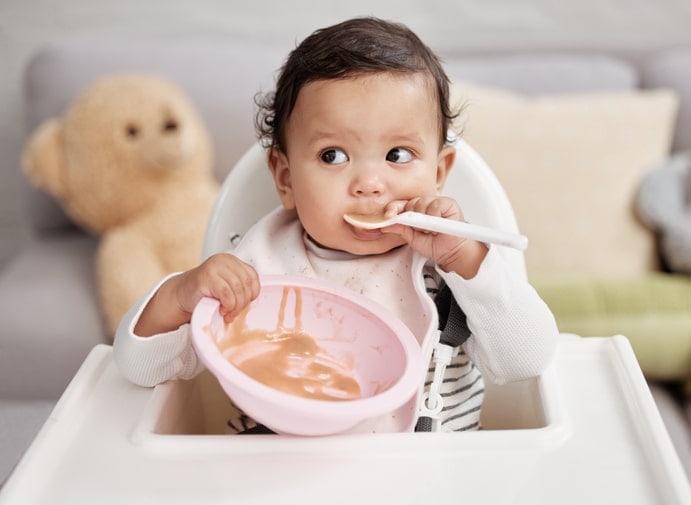
image of baby self-feeding with spoon by istock / PeopleImages