Studies suggest the answer is yes…if the game has these particular features.
You might not expect much from a preschool board game. Players roll dice, or spin a spinner, and move their game tokens around a board.
But when young children play number-based board games, something exciting can happen. If a game requires that players move their game tokens along an ascending sequence of numbered spaces — and speak these numbers out loud — it can help kids develop a crucial understanding of the number line.
They can build an intuitive appreciation for “how much” different numbers represent. A feeling for numbers gets encoded in the brain.
That bodes well for the future. Studies show that early “number sense” predicts long-term achievement in mathematics. The stronger a youngster’s mathematical intuitions about quantity and the number line, the better he or she performs on mathematics tests in primary and middle school (Laski and Siegler et al 2013).
For example, when David Geary tracked kids over the course of several years, he found that first graders were more likely to develop strong math skills if they were good at number line estimation — a task that requires kids to indicate where, approximately, a given number should appear on a number line (Geary 2011).
The effect remained even after Geary held other factors — like IQ test scores — constant, suggesting that the results weren’t merely the reflection of differences in general ability (Geary 2011). And, in subsequent years, researchers in countries around the world have confirmed the links between number line estimation and other mathematics skills (e.g., Schneider et al 2018; Ouyang et al 2021; Gunderson and Hildebrand 2021). When kids possess a strong intuition for the number line, they are better equipped to reason about addition, subtraction, and other mathematical operations.
So there’s reason to think that the right game can help children build important mathematical knowledge. But how does it work, and what can adults do to make sure kids reap bigger benefits? Let’s take a closer look.
Children who play board games possess better math skills
In 2008, Neetha Ramani and Robert Siegler asked preschoolers to name all the board games they had ever played. They also asked the kids to name all the different places they’d played the games (for instance, at home, at school, or at a friend’s home). And the researchers uncovered a pattern. The more board games that a child named, the better his performance in four areas:
- Numeral identification
- Counting
- Number line estimation (in which a child is asked to mark the location of a number on a line)
- Numerical magnitude comparison (in which a child is asked to choose the greater of two numbers)
The same relationship was found for the number of settings in which kids played board games. Kids who played board games in multiple locations (e.g., their own home and the home of a friend) performed better on all four math tasks.
Similar results were associated with video games and card games, but to a much lesser degree. Kids who played more video games or card games performed better in only one of the four areas of mathematical knowledge (Ramani and Seigler 2008).
Of course, correlation doesn’t prove causation. Board game experience might be linked with mathematical performance due to confounding factors. For instance, children who play board games might tend to come from more affluent families, which would provide them with other advantages.
But Siegler and Ramani noted that certain board games seem tailor-made to teach mathematical concepts. For example, the Chutes and Ladders game requires players to move their game tokens through a series of consecutively-numbered spaces. The game board is essentially a number line, and children who play the game get to experience magnitude in a hands-on, concrete way.
- Spaces marked with higher numbers are physically farther along the number line.
- Moving your token to these more distant locations requires more moves.
- It takes more time to reach spaces with higher number values.
If children count out loud — speaking the numbers on the board as they move — they may also pay more attention to ordered relationship between these numbers.
So it makes sense that a game like this could help children develop their mathematical intuitions. And the researchers found additional correlations to support their hunch: Children who reported playing Chutes and Ladders were better at identifying numerals and interpreting number lines. They were also less likely to make mistakes during counting.
Putting it to the test: Can playing a game really help children develop better number sense?
To find out, Ramani and Siegler created their own, simplified, board games, and randomly assigned preschoolers to participate in one of two training programs:
Kids in the number-based game program played a mathematical board game — a simple race-to-the-finish where players took turns moving their tokens along a series of twenty, consecutively-numbered squares. For each move, these children were also instructed to “count on” from whatever number their token started from. Thus, if a player began a turn with his token on a space marked “7,” he would move his token forward the required number of spaces while counting aloud: “8…9…10…”
Kids in the color-based game program played a similar, race-to-the-finish game that differed in only one respect: The game board squares varied by color instead of number.
The programs lasted only two weeks, and consisted of just four game sessions of 15-20 minutes. But that was enough to make a difference.
Compared with their baseline skills before starting the intervention, the color-based preschool board game showed no improvement. By contrast, children who played the math-based preschool board game improved in all four skill areas assessed — numeral identification, counting, number line estimation, and numerical magnitude comparison.
Moreover, the gains were long-lasting. When the same kids were tested 9 weeks later, they still showed superior math skills (Ramani and Siegler 2008).
The importance of “counting on” — don’t skip it!
Ramani and Siegler replicated the effect with middle income children, and researchers working independently in Scotland have obtained similar results (Ramani and Siegler 2011; Whyte and Bull 2008). Most recently, Chien-Heng Lin conducted a non-randomized experiment on children in Taiwan, and found that number line games were more effective than non-number line games in boosting number knowledge and arithmetic skills (Lin 2022).
But not every numerical board game has been linked with impressive gains, and Robert Siegler has a possible explanation. In studies where kids showed less extensive improvement, they weren’t required to “count on.” Siegler thinks that’s important because “counting on” forces kids to take note of the numbers printed on the board.
Without this requirement, the child who has to move her token three spaces forward from the “7” space might simply do it by counting “1,2,3,” and pay little attention to the fact that she’s moved along the number line from 7 to 10. What he doesn’t notice, he won’t encode. He’s only focused on counting from 1 to 3, and misses the bigger lesson.
In support of this idea, Siegler and Elida Laski have shown that kindergartners assigned to play a number board game were more likely to benefit when they were coached to “count on.” The researchers created an expanded version of the original number game, one that featured 100 spaces instead of 20. Then they assigned 42 kindergartners to play the game in one of two ways.
- Half the children were told to count from 1, meaning that they counted aloud from 1 until they had moved their token forward the required number of spaces. Under this condition, kids were expected to pay less attention to the numbers on the board, and therefore learn less.
- The other half of the kids were instructed to count on, and thus expected to learn more.
The children played the game 8 times over the course of three weeks. They were given mathematics tests at the end of the study, and the results were compared with their baseline scores. Researchers also monitored progress during the study, and the difference between groups was substantial.
The kids who had “counted on” experienced impressive improvements in numeral identification, number line estimation, and the ability to count from numbers other than one. And these improvements were roughly twice as large as the gains observed in the children who had counted from one (Laski and Siegler 2014).
How to find the right preschool board game
Siegler and his colleagues make a compelling case. The next question is: What board games are most likely to benefit your child?
The good news is that it’s likely that many games can be helpful, as long as they include counting tasks. For example, in a recent experimental study in Germany, 4- and 5-year-old children honed their counting skills after playing conventional board games that included the game mechanic of rolling traditional dice (the kind that display a different number of dots on each face) to determine a player’s actions (Gasteiger and Moeller 2022).
And, as noted above, research suggests that Chutes and Ladders might help kids learn about the relative magnitude of numbers.
But some of the conventional games tested in the German study had pretty complex-looking boards, and Chutes and Ladders typically features numbers up to 100. Moreover, the rules of these games can be relatively complicated.
So if your child is just beginning to learn to count, it makes sense to start with the same game that Siegler and Ramani used in their experiments. For details, see this article about creating your own version of their preschool board game, as well as step-by-step instructions for creating a preschool card game that has also been demonstrated to boost children’s math skills.
You might also be interested in this guide to preschool math activities (which includes some number games) and my research-based guide to board games for kids.
References: Math skills and the preschool board game
Dehaene S. 1997. The number sense: How the mind creates mathematics. New York: Oxford University Press.
Duncan GJ, Dowsett CJ, Claessens A, Magnuson K, et al. 2007. School readiness and later achievement. Developmental Psychology 43(6): 1428-1446.
Gasteiger H and Moeller K. 2021. Fostering early numerical competencies by playing conventional board games. J Exp Child Psychol. 204:105060.
Geary DC. 2011. Cognitive predictors of achievement growth in mathematics: A 5-year longitudinal study. Developmental Psychology, 47(6), 1539–1552.
Geary DC. 2006. Development of mathematical understanding. In: W. Damon and RM Lerner (eds), Handbook of child psychology, V. 2: Cognition, perception, and language. 6th ed. Hoboken, NJ: Wiley.
Geary DC, Bow-Thomas CC and Yoa Y. 1992. Counting knowledge and skill in cognitive addition: A comparison of normal and mathematically disabled children. Journal of Exp Psych 54(3): 372-391.
Gunderson EA and Hildebrand L. 2021. Relations among spatial skills, number line estimation, and exact and approximate calculation in young children. J Exp Child Psychol. 212:105251.
Laski EV and Siegler RS. 2014. Learning from number board games: you learn what you encode. Dev Psychol. 50(3):853-64.
Lin CH. 2022. Developing mental number line games to improve young children’s number knowledge and basic arithmetic skills. J Exp Child Psychol. 222:105479.
Ouyang X, Yang Y, Zhang X, Zhang Q. 2021. Longitudinal relations between the approximate number system and symbolic number skills in preschool children. J Exp Child Psychol. 212:105254.
Ramani GB and Siegler RS. 2008. Promoting broad and stable improvements in low-income children’s numerical knowledge through playing with number board games. Child Development 79(2):375-394.
Schneider M, Merz S, Stricker J, De Smedt B, Torbeyns J, Verschaffel L, Luwel K.2018. Associations of Number Line Estimation With Mathematical Competence: A Meta-analysis. Child Dev. 89(5):1467-1484.
Siegler RS, 1988. Strategy choice procedures and the development of multiplication skill. Journal of Experimental Psychology: General 117: 258-275.
Whyte JC and Bull R. 2008. Number games, magnitude representation, and basic number skills in preschoolers. Developmental Psychology 44(2):588-96.
Content last modified 9/2022. Large portions of this text are derived from a previous version of this article written by the same author.
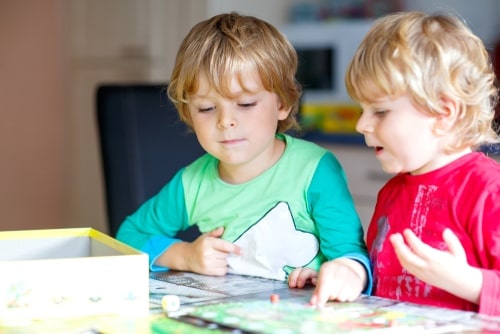
Image of children puzzling over game by shutterstock / Irina Wilhauk
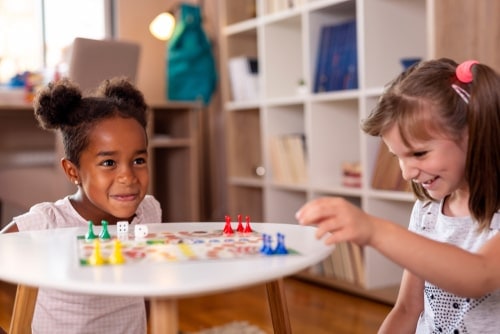
image of girls smiling while playing a board game with colorful game pieces and dice by Impact Photography / Shutterstock