Preschool math lessons don’t have to be tedious, and they don’t need to be narrowly focused on learning to count. Here I review the highlights of research about early mathematics education, along with specific tips for creating mathematical experiences that are playful and stimulating. I also present some research-inspired number activities and math games designed to help preschoolers hone their number sense.
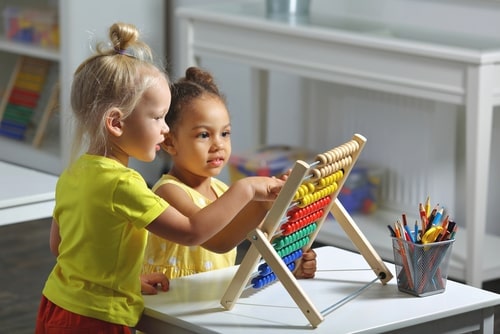
The payoff? By sharing these experiences, you get to watch your child’s mind at work. And your child gets to learn about numbers through play and exploration.
It’s approach that works. When researchers used fun board games to teach preschool math concepts, children made lasting improvements in their mathematical ability (Whyte and Bull 2008; Ramani and Siegler 2008).
Such improvements may bode well for future achievement. An analysis tracking thousands of English-speaking students found that kids who entered kindergarten with a strong grasp of
- counting
- relative magnitudes, and
- ordinality (sequencing magnitudes)
achieved better math scores in the later years.
Moreover, these preschool math skills were more predictive of general scholastic achievement than were language, attention, or social skills (Duncan et al 2007).
That doesn’t mean that preschool math lessons cause better scholastic achievement. But it suggests that preschool math ability is an important bellwether of a child’s scholastic preparation.
So let’s get down to business. How can we create preschool math lessons that are stimulating for kids and their teachers?
Understand that number sense is distinct from a knowledge of counting
Preschool math lessons often emphasize counting, and for good reason. Understanding the counting system is a prerequisite for learning about the number line. It also helps kids grasp the concept of addition.
But it’s important to realize that children can develop number sense without knowing the names of numbers.
In a way, this shouldn’t surprise us. After all, even nonhuman animals have reason to keep track of quantity. Which tree bears more fruit? If three predators hide behind a rock, and one walks away, how many are left?
Studies show that all sorts of non-linguistic animals — birds, rats, monkeys — can solve such problems (Dehaene 1999). And research also suggests that human children can perform basic mathematical tasks without knowledge of number words.
Case in point: Research conducted by cognitive neuroscientists on kids who speak only Walpiri or Anindilyakwa, two native Australian languages (Butterworth et al 2008).
These languages include number words for only three numerosities–“one,” “two,” and any imprecise quantity that is “more than two.” Yet 4- to 7-year old speakers of these languages performed as well or better than English speakers when they were asked to
- briefly examine a small set of tokens and then assemble an identical set of tokens from memory;
- listen to a series of up to 7 taps and then place the corresponding number of tokens on a mat;
- spontaneously subdivide a set of 6 or 9 items into three equal sets when they were told to “share” these items among three toy bears; and
- briefly observe two small sets of tokens and assemble a third set of tokens that represented the sum.
Again, these kids knew no words for specifying precise quantities of more than two.
What are the implications? Kids can learn a lot about numbers without knowing how to count. Preschool math lessons can extend to activities that don’t require counting at all.
In fact, research suggests that kids need to learn a lot about numbers before they begin to label specific quantities with counting words. We can use this information to design a variety of interesting preschool math lessons.
Help your child develop a strong sense of “numerosity” and other basic math concepts
Numerosity
How many cats are in your backyard? How many hours are left before bedtime? Psychologists use the term “numerosity” to denote the number of things in a set.
Numerosity is the conceptual bedrock for most basic math skills. Kids who don’t grasp numerosity—as an abstract concept and as an intuition about the meaning of specific magnitudes—have trouble understanding the counting system. They also have more difficulty with arithmetic and making measurements (Booth and Siegler 2006; Siegler and Booth 2004).
How can we help kids learn about numerosity? Recent experiments on American first graders suggest that approximation activities are helpful. Show kids two sets of objects and ask them to judge which is bigger — without counting (Hyde et al 2104).
Such activities might help preschoolers, too. But very young children have a lot more to learn. They need to know that specific numbers signify, or map onto, specific quantities. And this understanding may improve with practical, hands-on experience with real sets (Dehaene 1999; Hirsh-Pasek et al 2003).
Consider, for instance, how everyday games can help children learn these crucial concepts (Butterworth 1999):
- The “one-to-one principle.” How do you know if two sets have the same numerosity? Your child can check by matching up the members of each set in one-to-one correspondence. If they can do this with nothing left over, the numerosity is the same. How many? Help you child count when you’re done. You can also pose a simpler, but related task to your child: Have a tea party in which each attendee (human, stuffed animal or action figure) gets one of each item—plate, cup, spoon, cookie, etc.
- Numerosity can apply to sets of anything. You can drive this point home by having kids work with a variety of objects as well as intangible things, like the number of times they hear you clap.
- The numerosity of a set can be changed by addition or subtraction. Games like Hi Ho Cherry-O help kids put this concept into practice. What happens to your tree of cherries when you add one cherry? Or take one away?
Counting
Counting skills depend on a child’s grasp of numerosity, including an understanding that (1) each number word picks out a specific numerosity, and (2) each item to be counted is counted once and only once. In addition, as cognitive psychologists Rochel Gelman and Randy Gallistel have noted (1978) kids also need to learn that:
- number words must be recited in the same order (aka the “stability principle”)
- later number words in the counting sequence refer to bigger numerosities
- the last word counted represents the numerosity of the set (aka the “cardinality principle”)
For help teaching these concepts, see my research-inspired, play-based preschool math lessons and my instructions for creating your own experimentally-tested preschool board game.
Start preschool math lessons the right way by building on what your child already knows
Remember the birds and rats I mentioned above? Pre-linguistic humans have some math savvy, too, which means your preschooler isn’t a blank slate.
Elsewhere, you can read more about what babies know about numbers. But, for now, here are the highlights:
Even babies know something about very small numbers.
Experimental studies suggest that 14-month old infants can keep precise track of quantities up to 3—remembering, for instance, if a box contains 1, 2, or 3 balls (Feigenson and Carey 2003).
Babies also know something about the approximate, relative value of different numbers.
Show babies a series of visual displays—each featuring an array of dots—and their brains will respond differently depending on what they see. A baby who is used to seeing displays of 4 dots will perk up when you show her a display of 8 dots (Izard et al 2008).
There are limits to these abilities. For instance, babies don’t understand the meaning of counting words. And babies don’t make fine distinctions between number sets. Ten-month old babies, who can distinguish between sets of 8 and 12 objects, do not discriminate between sets of 8 and 10 objects (Xu and Arriaga 2007).
But the important point is this: By the time your child is 2-3 years old, he already knows something about tracking very small numbers, and he understands something about “greater than” and “less than.”
These findings indicate a good starting point for preschool math lessons:
- The first three numbers. Focus on learning the words for numbers 1-3 and you’ll be working with your child’s pre-existing number sense.
- Relative magnitudes. You can help kids sharpen their intuitive sense of “how much” a number represents by encouraging them to compare and arrange sets of objects in order of relative magnitude.
Be patient
It’s one thing to keep track of three objects, another to understand that the number term “3” refers to all sets of three things. If your child is just starting to learn about numbers, expect slow progress.
Research suggests that a 2- or 3-year old kid who has learned the meaning of “1” will take another six months to learn about “2” and three months beyond that to learn about “3.”
Altogether, it can take kids about a year to really understand how the counting system works (Wynn 1992).
Be ready for a faster pace after your child has mastered numbers up to 4
Once your child really “gets” the first four numbers, he will probably find it much easier to tackle higher numbers (Wynn 1992).
Don’t push. Learning should be spontaneous and fun.
Granted, there is some debate about whether or not it’s a good idea to push an academic curriculum on young children. At present, I can’t find any experimental studies addressing the question. So the jury is still out.
But I think it’s significant that the vast majority of human societies don’t expect children to sit still for formal education until they are between 5 and 7 years old. This may reflect a universal trend of brain development. The frontal lobes—-which permit us to reflect, reason, and control our impulses-—don’t begin to mature until children are around 5-6 years old (Eliot 2000).
Formal instruction before this age may therefore be an exercise in futility, or at least frustration. And even if kids learn something this way, is it worth it?
Some researchers are concerned that an overly-regimented approach to early childhood education could backfire, making restless young children develop negative attitudes about school (Blakemore and Frith 2005; Diamond and Hopson 1999).
As I’ve written elsewhere, some school kids are developing math anxiety as early as the first grade. The results can be intellectually crippling, because anxious kids are more likely to avoid math practice and fall behind.
Given these concerns, I think it makes good sense to play it safe and avoid preschool math lessons that feel like lectures or drills. Learning about math should be fun, and—-ideally-—should reflect your child’s own spontaneous interest.
Help unfocused, distractable kids prepare for kindergarten math by improving their self-control
A recent study tracking 228 American children reports a link between early math skills and self-control. Three-year-olds who scored low on executive control — the ability to regulate one’s impulses and attention — had poorer math skills in kindergarten (Clark et al 2012).
Does this mean that every preschooler with weak executive control is headed for trouble with mathematics? No. But given the evidence that we can help kids develop better self-control, it seems a good idea to identify struggling kids and invest some effort in boosting their executive control. For more information, check out my evidence-based article about teaching self control.
References: Preschool math lessons
Blakemore SJ and Frith U.. 2005. The learning brain: Lessons for education. Malden, MA: Blackwell Publishing.
Booth JL and Siegler RS. 2006. Developmental and individual differences in pure numerical estimation. Developmental Psychology 41: 189-201.
Butterworth B, Reeve R, and Lloyd D. 2008. Numerical thought with and without words: Evidence from indigenous Australian children. Proceedings of the National Academy of Sciences 105(35): 13179-13184.
Clark CA, Sheffield TD, Wiebe SA, and Espy KA. 2012. Longitudinal Associations Between Executive Control and Developing Mathematical Competence in Preschool Boys and Girls. Child Dev. 2012 Sep 24. doi: 10.1111/j.1467-8624.2012.01854.x. [Epub ahead of print]
Dehaene S. 1997. The number sense: How the mind creates mathematics. New York: Oxford University Press.
Duncan GJ, Dowsett CJ, Claessens A, Magnuson K, Huston AC, et al. 2007. School readiness and later achievement. Developmental Psychology 43(6): 1428-1446.
Diamond MC and Hopson J. 1999. Magic Trees of the Mind : How to Nurture Your Child’s Intelligence, Creativity, and Healthy Emotions from Birth Through Adolescence. New York: Plume.
Eliot L. 2000. What’s going on in there? How the brain and mind develop during the first five years of life. New York: Bantam.
Feigenson L and Carey S. 2003. Tracking individuals via object-files: Evidence from infants’ manual search. Developmental Science, 6: 568-584.
Gelman R and Gallistel R. 1978. The child’s understanding of number. Cambridge, MA: Cambridge University Press.
Hirsh-Pasek K, Golinkoff RM and Eyer D. 2004. Einstein Never Used Flashcards: How Our Children Really Learn–and Why They Need to Play More and Memorize Less. Emmaus, PA: Rodale.
Hyde DC, Khanum S, Spelke ES. 2014. Brief non-symbolic, approximate number practice enhances subsequent exact symbolic arithmetic in children. Cognition. 131(1):92-10.
Izard V, Dehaene-Lambertz G, and Dehaene S. 2008. Distinct Cerebral Pathways for Object Identity and Number in Human Infants . PLoS Biol 6(2): e11.
Ramani GB and Siegler RS. 2008. Promoting broad and stable improvements in low-income children’s numerical knowledge through playing with number board games. Child Development 79(2):375-394.
Siegler RS and Booth JL. 2004. Development of numerical estimation in young children. Child Development 75: 428-444.
Whyte JC and Bull R. 2008. Number games, magnitude representation, and basic number skills in preschoolers. Developmental Psychology 44(2):588-96.
Wynn K. 1992. Children’s acquisition of the number words and the counting system. Cognitive Psychology 24(2): 220-251.
Xu F and Arriaga RI. 2007. Number discrimination in 10-month-old infants. British Journal of Developmental Psychology (25)1: 103-108.
Written content of “Preschool math lessons” last modified 2/14
image of little girls playing with abacus by ShineTerra / shutterstock