Preschool number activities often involve counting, but counting alone – naming numbers in the right order – isn’t enough. Children also need to develop “number sense,” an intuitive feeling for the actual amount associated with a given number. Where does number sense come from, and what can we do to make sure kids really learn the concept of number?
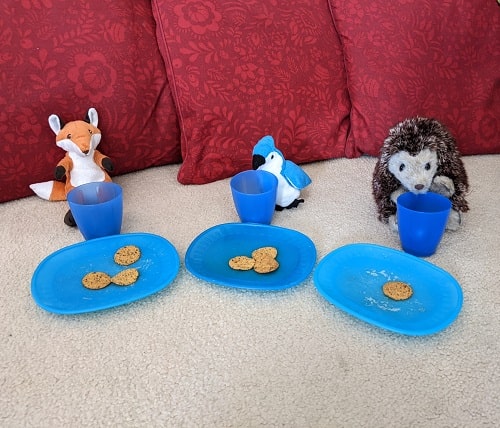
Experiments suggest that even 6-month-old infants can tell the difference between 4 cookies and 8. And 14-month-old babies seem to grasp that counting tells us something about quantity (Wang and Feigenson 2019). So that’s a start. What’s needed — as kids get older — are hands-on experiences.
When should we begin teaching children about numbers?
It’s possible to start as soon as your child has developed the ability to learn a string of words, but it’s important to know that the process is gradual.
For example, in the United States, kids often begin to practice verbal counting around the age of two. But they will need lots of practice to avoid making errors (such as skipping a number, or getting the order wrong). And these early learners don’t really understand the meaning of number words.
When does this understanding finally come together? It usually takes a year or two after they begin participating in number activities. Through repeated exposure and practice, they gradually learn what exact quantities are indicated by the words “one,” “two,” “three,” and “four.” Then – eventually — they figure out they can use counting to determine the numerosity of any set (Wynne 1990; LeCorre and Carey 2007; Carey and Barner 2019).
How can we help kids learn about numbers?
Research is pretty compelling on this point: Kids benefit when we actively teach them – introduce them to the concepts and terminology, and give them plenty of opportunities to work with numbers.
The following evidence-based number activities encourage kids to think about several key concepts, including
- The stable order principle (number words must be recited in the same order)
- The principle of increasing magnitudes (as we count higher, the numbers represent greater numerosities)
- The one-to-one principle of numerosity (two sets are equal if and only if their items can be placed in perfect, one-to-one correspondence)
- The one-to-one principle of object counting (each item is to be counted is counted once and only once)
- The cardinal principle (the last word counted represents the numerosity of the set)
They also give children practice naming numbers – recognizing the verbal labels, and connecting them with the correct, symbolic (Arabic) numerals.
As your child engages in these preschool number activities, keep in mind this advice (from my guide to preschool math lessons):
- Start small. It’s important to adjust the game to your child’s attention span and developmental level. For beginners, this means counting tasks that focus on very small numbers (up to 3 or 4).
- Make sure it’s fun. If it’s not playful and fun, it’s time to stop.
- Be patient. It takes young children about a year to learn how the counting system works.
Evidence-based preschool number activities
Your child’s first counting activities
As noted above, most kids are ready to begin verbal counting by the age of two, and one classic approach is to recite together – in unison – for fun.
But there are also ways to incorporate counting into games. For example, researchers suggest that you can play “Hide and Seek,” where players must learn to wait for a count before beginning a search. “One…two…three…here I come!” (Levenson et al 2022). Other ideas for combining counting with play include:
- a dancing game, where players must freeze until someone has finished a brief count;
- walking up a stair case, while counting each step
- moving forward in a room, or outdoors, while counting each step
Your child won’t necessarily learn what quantities are associated with each number. But they will be learning the stable order principle – that there’s a correct sequence to follow. And verbal counting will pave the way for deeper lessons.
Picture book-based activities for teaching kids about using counting to determine the number in a set
I mentioned above that children eventually make a breakthrough of understanding: They realize that they can use counting to determine the exact quantity of any set. For example, if you ask them to select exactly 6 toys from a box, they will be able to do it. “Oh…I just need to keep collecting toys until I’ve reach a count of six.” They’ve figured out the cardinal principle.
But this breakthrough doesn’t just happen. Studies suggest that it depends, in part, on children first gaining a concrete feeling for the amounts specified by “one,” “two,” “three,” and “four,” and being shown how we can use counting to check. And a team of researchers – lead by Kelly Mix – have come up with an interesting approach that parents can use at home when they are reading to their preschoolers.
It works like this. Suppose you are reading a storybook with your child, and you come across three bears. Call attention to the number of bears you see, and then guide your child through a count of them. “Look, I see three bears! Can you say it with me? Three bears. Let’s count: One, two, three.”
Next, ask your child to repeat the process on his or her own. “Now it’s your turn. How many bears are there?”
Encourage your child to perform both parts of the number task – counting the bears again, and labeling the total number in the set. Here’s the feedback you can provide to make sure this happens:
- If your child merely says that there are three bears, but doesn’t count them, say, “Right! There are three bears. Can you count them?”
- If your child correctly labels the total number of bears, but makes an error while counting, say “Right! There are three bears, but watch: 1, 2, 3.”
- If your child counts the bears correctly, but fails to label the set, say: “Right! 1, 2, 3…So, how many are there?”
Kelley Mix and her colleagues tested this approach in a randomized experiment on children who were 3 ½ years old, along with some alternative methods – like merely asking kids to count objects (e.g., “Let’s count the bears!”) or simply telling kids about quantity (“Look! This page has three bears. Can you say it with me? Three bears…).
After 3 weeks of daily training, the kids who had been randomly assigned to the combination approach (label first, then count, and ask kids to do the same) made significant gains in their ability to understand and count sets larger than 5. In fact, they were the only kids who experienced significant improvements. The researchers conclude that children made progress in understanding the cardinal principle (Mix et al 2012).
Preschool number activities for teaching the one-to-one principle of numerosity
Matching items one-to-one is a surprisingly important mathematical concept. It’s how we prove that two quantities are equal. Two sets contain the same number of items if the items in each set can be matched, one-to-one, with no items left over. Researchers call this the “one-to-one principle of numerosity,” and you can help kids master the concept with these simple, preschool number activities.
Free play using “objects with slots”
Imagine a muffin tin with 6 slots, and a set of balls that fit inside – one ball per opening. If kids play with something like this, will it help them learn to think about matching items one-to-one?
Dr. Kelly Mix thought this might work, so she tested it in a randomized experiment on 30 preschoolers (3-year-olds). Half the children were given “objects with slots” to play with (e.g., 6 balls and a 6-slot muffin tin). The remaining kids were given a double set of toys without a container (e.g., 6 balls and 6 frog toys). The parents were told to encourage kids to play with the toys at home, and then, 6 weeks later, the researchers tested children to see if they had improved their understanding of one-to-one matching. Kids in both groups saw improvements, but those who played with “objects with slots” made bigger gains overall (Mix et al 2011).
Game: Duplicate a set using small tokens or counters
Can your child assemble a set of two items? Three items? More? To play this number game, set up two, adjacent zones on a table top or other flat surface (such as the floor). You can use two placemats or floor mats to define your areas. Alternatively, you could draw chalk boundaries around each zone (on a pavement), or mark the borders with colorful tape (on a carpet).
Next, place a small number of tokens in one the zones, and ask your child to fill up the other zone with the same number of tokens. You can say something like, “Can you make another set of tokens like this one? So that it has the same amount?” After your child has made an attempt, count the members of each set to see if they match, and label the sets as described in the previous activity (e.g., “1, 2, 3, 4, 5. There are five tokens!”)
For a variant of this game, create a set of index cards, each card displaying a different number of dots. Select a card to challenge your child with, and ask him or her to create a matching set of tokens. Follow up in the same way, asking your child to count and label the set.
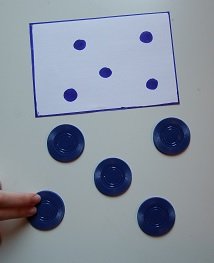
Tip for starting out: Begin with very small numbers. It can take almost a year for a two- or three-year-old to really understand how the counting system works, so don’t be surprised if younger children have trouble counting beyond “1-2-3.” Help your child with counting if needed, and expand set size gradually as your child’s skills grow.
What should you use for tokens? For children under the age of three years, it’s important to choose something that won’t pose a choking hazard. According to the U.S. Consumer Product Safety Commission, a ball-shaped object is unsafe for children under 3 years if the item is smaller than a 1.75″ diameter golf ball. Other objects are unsafe if they can fit inside a tube with a diameter of 1.25″ inches. Pieces from your toddler’s building block set might do the job.
Also, try to use plain-looking tokens. You might think that little toy frogs or spiders would make counting more fun. But researchers have found that young children tend to get distracted by these details. Kids actually learn more from math activities when they manipulate simpler, more abstract items (Petersen and McNeil 2012). Plastic chips — like those used for poker or bingo — are a good choice for children aged 3 and up.
Sharing at the tea party: Dividing up tokens into equal portions
Here is another activity to help kids practice one-to-one matching, inspired by the research of Brian Butterworth and his colleagues (2008).
Choose three toy creatures to play the part of party attendees, and have your child set the table for them. Then give your child a set of “goodies” (tokens or real edibles) to share with the party guests. The total number of goodies should be a multiple of 3, so your child can distribute all the items equally and have no leftovers.
If your child makes a mistake and gives one creature too many tokens, you can voice the part of one of the other characters and complain. You can also take turns playing the role of the tea party host and deliberately make a mistake. Ask for your child’s help. Did someone get too many tokens? Or not enough? Have your child fix it.
Activities for teaching the principle of increasing magnitudes
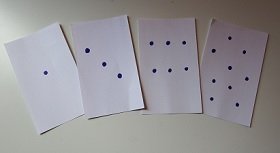
For these preschool number activities, use cards like those described the previous section. You can use them in three ways.
Game: Guess the right order
To play this game, shuffle the cards, and then ask your child to place them, side by side, in a sequence of increasing magnitude.
For children who haven’t yet learned to count, use cards that vary by a substantial amount, e.g., 3, 6, 10, and 15. For children with emerging counting skills, use cards that differ by a single dot, and have kids guess first, then check their answers by counting.
What’s the point of all this guesswork? Experiments show that even babies can spot differences this large, and practicing these tasks may help children hone their estimation abilities — abilities which are essential for future mathematics achievement.
For example, in one study, researchers tested five-year-olds with computer-based versions of these preschool number activities. The children weren’t given enough time to count; they simply took a quick look and answered based on their intuitive, visual impression. Kids who practiced making progressively more difficult discriminations — getting accurate feedback after each attempt — experienced subsequent improvements in their ability to solve problems using symbolic numbers (Wang et al 2016).
Game: Guess which card has more dots?
To play this game, select two cards, each displaying a different number of dots, and show them to your child. Which card has more dots?
Make sure you start with cards that differ by a ratio of at least 2:1. For instance, try 1 vs. 2, 2 vs. 4, and 2 vs. 5. You can also try larger numbers, like 6 vs. 12.
As your child gets practice with these easy-to-discriminate differences, you can present her with increasingly difficult choices (like 6 versus 8; or even 9 versus 10).
For a more playful variant of the game, you can use tokens instead of cards, and pretend they are something fun, like cakes. Dole out different amounts between you and ask, “Who has more?” Be sure to give your child feedback about the correct answer.
And as kids become more skillful, you can use your cards in a competitive game called, “Number Battle” (Scalise et al 2017). See my article, “DIY Preschool math games that help kids develop ‘number sense’” for a full description of the rules.
Game: Big guys eat more
To play, use your cards, as well as three animal toys or dolls of varying size — small, medium, and large. Pretend the toys are party guests, and the items on the cards are treats. Next:
- Line up the three toys in order of size.
- Present your child with three cards, each card depicting a different number of dots.
- Ask your child to give the greatest number of treats to the largest toy, the second-greatest number to the second-largest toy, and the smallest number to the smallest toy.
After your child has distributed the goodies, provide pleasant, encouraging feedback. “That’s right!” (for a correct response), and “That’s not right…can you try again?” (for an incorrect response).
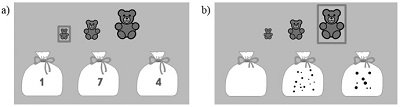
If you prefer, you can play the game with tokens instead of cards. And once your child has started to read and understand number symbols, you can use cards that display only Arabic numerals. This will help kids practice number recognition.
When researchers tested similar preschool number activities, they found that both dot-based and numeral-based games helped children develop better intuitions about quantity. But kids who played the Arabic numeral version of the game experienced greater growth in basic arithmetic skills (Honoré and Noël 2016).
Pretend play activities for teaching kids about number symbols
What else can we do to foster learning about number symbols – like the Arabic numeral “3”? In their review of educational math games for preschoolers, Julie Sarama and Douglas Clement (2009) remind us that even unstructured, pretend play can turn into number recognition activities.
To illustrate, they cite an example of two preschoolers engaged in fantasy role-playing about a “Dinosaur Shop.” One player acted as the shop keeper (offering toy dinosaurs for sale). The other player, the customer, had money (a deck of cards, with each displaying a different, Arabic numeral, a corresponding number of dots). The customer would purchase a number of dinosaurs by handing over a card: Give the shop keeper a card with the number “5” on it, and you should receive 5 dinosaur toys in return. Then players could count to confirm an accurate transaction.
So games of buying and selling may help children learn about number symbols. And so, too, might these role-playing games:
- Making pizzas. Using cardboard disks and paper toppings, ask your pizza chef to make pizzas to order: Give the chef a number card, and have the chef create a pizza with the corresponding number of toppings. When the pizza is finished, the chef and customer can check for accuracy by counting the toppings and comparing this with the numeral on the card (Clements and Sarama 2009).
- Delivering the Mail. Set up a “street” with a series of different “homes” arrayed along it. Mark each home with a “resident” (a toy or doll), as well as a number card displaying the desired address. Make sure the addresses are lined up in numerical order (1, 2, 3…). Then ask your child to deliver the “mail” – letters and packages marked with the desired addresses.
A puppet game for teaching the one-to-one principle of counting objects, and the principle of cardinality
Here’s another “one-to-one” principle — this time the one-to-one principle of counting objects. Kids need to learn that each item in a series is counted once and only once. They also need to learn the principle of cardinality, the idea that the last word in our count represents the numerosity of a set.
Children learn these ideas through practice. But they might also learn by correcting others who make mistakes. In one study, researchers asked preschoolers to watch–and help–an incompetent puppet count a set of objects (Gelman et al 1986). The puppet would occasionally violate the one-to-one principle by double-counting (e.g., “one, two, three, three, four…). He also sometimes skipped an object or repeated the wrong cardinal value.
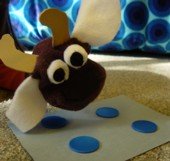
Kids ranging in age from 3 to 5 were pretty good at detecting these violations. So your child might have fun correcting your own goofball at home.
What if your child doesn’t notice an error? Correct the puppet yourself. And either way, ask your child to explain what went wrong. In another, similar study, researchers found that preschoolers didn’t make conceptual progress unless they were asked to explain the puppet’s mistakes (Muldoon et al 2007). For a discussion of how self-explanation can make preschool number activities and other educational experiences more valuable, see this Parenting Science review of the evidence.
Another puppet-based game that might help preschoolers develop intuitions about addition and subtraction
Young children have a long way to go before they are ready to perform basic arithmetic calculations like “2 +3 = 5,” or “7 – 3 = 4.” But we might be able to build their intuitions about addition and subtraction by asking the right questions. One way to do this is by playing a game.
You begin by pretending that someone (a puppet or toy character) has baked some “cakes” (a set of tokens). Ask your child to count the cakes (helping your child with this if needed).
Next, have the puppet bake one more cake and add it to the set. Are there more cakes or fewer cakes now? Ask your child, and provide him or her with correct feedback afterwards.
You can try the same thing with subtraction by having the puppet “eat” a cake. And vary the game by adding or subtracting other small amounts, like two or three.
Should we expect children to come up with accurate answers? Not necessary — especially not if they are under the age of three years (Izard et al 2014). But the experience of predicting and checking is valuable, and even when kids get the precise number wrong, they do a good job coming up with reasonable guesses. When researchers asked 3-, 4- and 5-year-olds to perform these tasks, they found that 90% of the guesses were in the right direction (Zur and Gelman 2004).
Board games that teach preschoolers about the number line
As your child begins to master the first few number words, you can also try out this DIY board game for teaching preschoolers about the number line. Along with full instructions for creating this game — a game tested by researchers — you will also find a discussion of whether kids can benefit from playing the traditional game, Chutes and Ladders.
References: Preschool number activities
Butterworth B, Reeve R, and Lloyd D. 2008. Numerical thought with and without words: Evidence from indigenous Australian children. Proceedings of the National Academy of Sciences 105(35): 13179-13184.
Carey S and Barner D. 2019. Ontogenetic Origins of Human Integer Representations. Trends Cogn Sci. 23(10):823-835.
Clements DH and Sarama J. 2009. Learning trajectories in early mathematics—sequences of acquisition and teaching. Encyclopedia of Language and Literacy Development (pp. 1–7). London, ON: Canadian Language and Literacy Research Network.
Evans AD and Lee K. 2013. Emergence of lying in very young children. Dev Psychol. 49(10):1958-63.
Gelman R and Gallistel C. 1978. The child’s understanding of number. Harvard University Press.
Gelman R, Meck E, and Merkin S. 1986. Young children’s numerical competence. Cognitive Development 1(1): 1-29.
Honoré N and Noël MP. 2016. Improving Preschoolers’ Arithmetic through Number Magnitude Training: The Impact of Non-Symbolic and Symbolic Training. PLoS One. 11(11):e0166685.
Izard V, Streri A, Spelke ES. 2014. Toward exact number: young children use one-to-one correspondence to measure set identity but not numerical equality. Cogn Psychol. 72:27-53.
Le Corre M and Carey S. 2007. One, two, three, four, nothing more: An investigation of the conceptual sources of the verbal counting principles. Cognition. 105:395–438.
Levenson ES, Barkai R, Tirosh D, Tsamir P. 2022. Exploring adults’ awareness of and suggestions for early childhood numerical activities. Educ Stud Math. 109(1):5-21.
Mix KS, Moore JA, and Holcomb E. 2011. One-to-one play promotes numerical equivalence concepts. Journal of Cognition and Development 12(4): 463-480.
Mix KS, Sandhofer CM, Moore JA, and Russell C. 2012. Acquisition of the cardinal word principle: The role of input. Early Childhood Research Quarterly 27(2): 274–283.
Muldoon KP, Lewis C, Francis B. 2007. Using cardinality to compare quantities: the role of social-cognitive conflict in early numeracy. Developmental Psychology 10(5):694-711.
Park J and Brannon EM. 2013. Training the Approximate Number System Improves Math Proficiency. Psychol Sci. 2013 Oct;24(10):2013-9.
Petersen LA and McNeil NM. 2013. Effects of Perceptually Rich Manipulatives on Preschoolers’ Counting Performance: Established Knowledge Counts. Child Dev. 84(3):1020-33.
Sarama J and Clements DH. 2009. Building Blocks and Cognitive Building Blocks: Playing to Know the World Mathematically. American Journal of Play. 1: 313-337.
Scalise NR, Daubert EN, Ramani GB. 2017. Narrowing the Early Mathematics Gap: A Play-Based Intervention to Promote Low-Income Preschoolers’ Number Skills. J Numer Cogn. 3(3):559-581.
Wang JJ and Feigenson 2019. Infants recognize counting as numerically relevant. Developmental Science 22(6): e12805.
Wang JJ, Odic D, Halberda J, Feigenson L. 2016. Changing the precision of preschoolers’ approximate number system representations changes their symbolic math performance. J Exp Child Psychol. 147:82-99.
Wynn K. 1990. Children’s understanding of counting. Cognition. 36(2):155-93.
Zur O and Gelman R. 2004. Young children can add and subtract by predicting and checking. Early childhood Research Quarterly 19: 121-137.
Content of “Preschool number activities” last modified 3/2023. Portions of the text derived from an earlier version of the article, written by the same author.
Image credits for “Preschool number activities”
title image of toys with plates and cups copyright Parenting Science
images of supplies for preschool number activities copyright Parenting Science
experimental image of bears and bags from: Honoré N and Noël MP. 2016. Improving Preschoolers’ Arithmetic through Number Magnitude Training: The Impact of Non-Symbolic and Symbolic Training. PLoS One. 11(11):e0166685. Image appears here courtesy Creative Commons Attribution License
image of puppet copyright Parenting Science