© 2008 – 2021 Gwen Dewar, Ph.D., all rights reserved
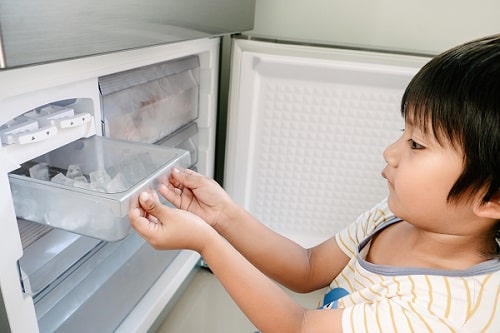
A preschool science experiment is an opportunity to introduce children to the concepts of observation, prediction, and testing (Gelman and Brenneman 2004).
Exciting? Yes. But it’s also tricky.
On the one hand, research suggests that young children don’t think as creatively or as critically when adults tell them what to do.
Simple instructions, like, “It works this way…” appear to deter kids from investigating and testing ideas of their own (Bonawitz et al 2011; Buchsbaum et al 2011).
It’s as if kids assume the adults have told them everything they need to know. All that is left is to carry out the procedures, faithfully and uncritically, whether or not they seem to make sense.
So when we give kids the chance to experiment, it’s important to avoid lectures, or the appearance that we have all the right answers. Children need to time to think, to generate their own questions.
On the other hand, kids benefit when we provide them with some structure. A few, organizing questions to pursue. A little guidance about procedure. Some coaching during the process.
When young children get this gentle, thought-provoking guidance, their investigations are more complex. They are more likely to discover deeper patterns (Bustamente et al 2018).
So it’s a balancing act. We need to give children the autonomy to explore, but we should also provide kids with support.
Here is an example of how we can do that: Some hands-on activities that introduce the scientific method, and present preschoolers (ages 4-6) with the mind-bending idea that matter can change states.
The activities involve ice cubes, which pose a safety risk. So be sure heed this warning.
Ice cube choking hazard
Ice cubes are a choking hazard to young children. Don’t give ice cubes to children under the age of 4, and be careful to supervise older children (ages 4-6). Make sure that kids don’t put ice cubes in their mouths!
Ready to begin? Start by giving kids the opportunity to explore.
Pre-experimental activity: Handling ice
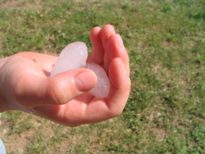
Before kids can test their ideas about ice, they need time develop their ideas. So put some ice cubes in a large pan or plastic container, and encourage kids to investigate.
As noted above, you need to make sure that children don’t put any ice cubes in their mouths. So you should participate, and keep a watchful eye.
But the goal is to let children make their own discoveries. Kids might try the following:
- Stirring
- Pouring
- Stacking
- Building
- Rubbing
- “Painting” (i.e., drawing ice cubes across different surfaces to see what tracks they leave behind)
Questions to ask
As children investigate, ask questions to provoke thought and discussion.
- How do ice cubes feel to the touch? (Cold? Wet? Slippery? Heavy? Smooth? Hard?)
- Is it hard to stack ice cubes?
- What makes ice melt?
- What eventually happens to your ice “paintings”?
If you like, you can also encourage children to record their observations — by drawing pictures, taking photographs, or having you take dictation.
The experiments
After kids have had the opportunity to explore the physical properties of ice, they’re ready to try these structured activities. They introduce children to the idea of making predictions (thoughtful guesswork about the outcome of an experiment) and checking the results.
They also present kids with the concept of contrasting two different conditions (e.g., warm water v. cold water).
Experiments #1 and #3 can be performed indoors. Experiment #2 should be performed outside on a sunny day. The hotter the better, but you will need a source of shade!
Preschool science experiment #1: The effects of warm water on ice
Materials
- Ice cubes
- Two bowls
- Cold and warm water
Procedure
Provide kids with two bowls of water — one warm, the other very cold. Let kids make observations about the temperature of the water (by testing it with their fingers). Then have them consider what will happen if you put an ice cube in each bowl.
Predictions
Ask kids to make a guess. Which cube will melt faster? Why?
Checking
Watch the ice cubes closely and discuss outcomes.
Preschool science experiment #2: Shade versus sun
Materials
- ice cubes
- shady and sunny surfaces
Predictions
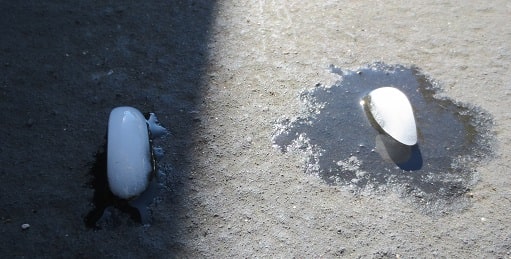
Before beginning the experiment, start a discussion about what makes ice melt. Ask kids to make a guess: Where do you think ice will melt faster? In the shade, or in the sun?
Checking
Have kids to put one ice cube in the shade and the other in sun. Watch and note the results.
Discuss outcomes
Why did the ice left in the sun melt faster? Ask kids to stand in the sun and then stand in the shade. Can they feel the difference?
Preschool science experiment #3: Less ice versus more ice
Materials
- ice cubes
- two large bowls
- two small paper or plastic cups
Procedure
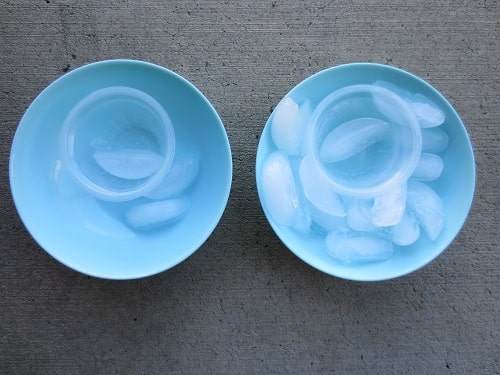
Put an ice cube in each cup. Then, in the first bowl, place 1 or 2 ice cubes. In the second bowl, place many ice cubes (10 or more).
Predictions
In this experiment, kids will place each cup (containing an ice cube) in a bowl. Ask kids to consider what will happen.
In which of the cups will the ice cube melt faster? The bowl with only a couple of cubes? Or the bowl that is packed with cubes?
Checking
Place each paper cup in a bowl. Make sure that the cups are standing upright (so they don’t spill their contents). And make sure that the paper cup in the bowl full of ice is surrounded by ice cubes. Watch and note the results.
Discussing outcomes
Why did the ice cube in the packed bowl melt more slowly?
More ideas
For more activities and for tips about teaching science to young children, see my page on preschool science. In addition, check out this preschool science experiment about making mud bricks.
References
If you are a teacher interested in designing your own preschool science experiment, you might want to read Preschool Pathways to Science (PrePS): Facilitating Scientific Ways of Thinking, Talking, Doing, and Understanding by Rochel Gelman and her colleagues.
Bonawitz E, Shafto P, Gweon H, Goodman ND, Spelke E, and Schulz L. 2011. The double-edged sword of pedagogy: Instruction limits spontaneous exploration and discovery. Cognition. 120(3):322-30.
Buchsbaum D, Gopnik A, Griffiths TL, and Shafto P. 2011. Children’s imitation of causal action sequences is influenced by statistical and pedagogical evidence. Cognition. 120(3):331-40
Bustamante AS, Greenfield DB, and Nayfeld I. 2018. Early Childhood Science and Engineering: Engaging Platforms for Fostering Domain-General Learning Skills. Education Sciences, 8: 144.
Gelman R and Brenneman K. 2004. Science learning pathways for young children. Early Childhood Research Quarterly 19:150-158.
Content last modified 6/2021
Photo of child retrieving ice cubes from freezer by Patcharida / istock
Image of hand and ice cubes by photodrop @ jennifererix.com
Photo of ice cubes on the pavement by ParentingScience.com
Photo of ice cubes in blue bowls by ParentingScience.com