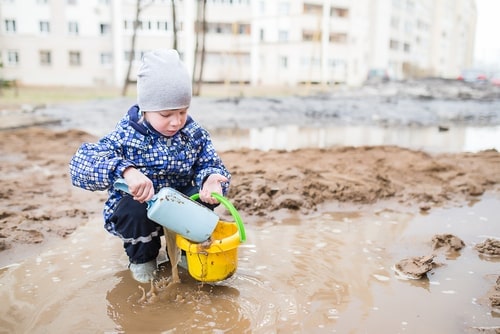
These preschool science projects permit kids to explore the properties of different kinds of dirt and mud.
Kids will make observations using their senses and some science tools, like a magnifying glass and some tweezers. Kids will also explore the concept of change as they turn dirt into mud—-and vice versa.
Ideally, these preschool science projects should be tackled in the order given below. Afterwards, your child might want to try this experiment in brick-making.
But remember — kids need lots of time to explore and discover on their own before they are ready to enjoy a structured experiment. So let kids play…and get dirty!
Project 1. Prospecting for dirt samples
Begin these preschool science projects by getting kids to consider where dirt comes from. If you have access to an outdoor source of dirt, take your kids on a dirt-collecting mission.
Materials
- buckets
- digging tools (trowels, spoons)
- containers with lids (recycled plastic food tubs) and
- supplies for labeling your dirt samples
What to do
Try to find more than one kind of dirt. Different types to look for include:
- dry, hard-packed dirt
- loose soil
- gravel
- silt
- sand
- clay
- dirt collected from under a tree (in the leaf litter)
Collect and label your samples using the recycled containers.
Questions to consider
As kids dig, encourage them to discuss what they observe.
- How does dirt differ from place to place?
- Where is the ground hard?
- Where is it soft?
- If the dirt is hard-packed, what’s the best way to loosen it?
- Is the dirt dry or moist?
- What does it feel like?
- What does it smell like?
- How is dirt collected from under a tree different from the dirt collected elsewhere?
- Do you see any leaves? Bugs? Twigs? Seeds? Clues that animals have been here?
Release any living creatures you find in your dirt samples and put each type of dirt in its own container and label where you found it. Keep these samples for other preschool science projects (see below).
Project 2. Exploring dirt
This activity is a follow-up to the dirt prospecting project described above.
Materials
- Different kinds of dirt
- Digging and stirring tools (trowels, sticks, spoons)
- Several sieves (with different-sized holes)
- Buckets or bowls
- Tray (e.g., a baking pan)
- Magnifying glass
- Tweezers
- Sheet of white paper
- Piece of black construction paper (half the size of the white sheet)
Preparation
You will need several different dirt samples. If you weren’t able to find a variety of dirt samples during your dirt prospecting mission, you may want to supplement with samples you find yourself (or purchase at a garden or landscaping store). Minimally, try to get samples of sand, topsoil, and a mixture of soil and fine gravel. If you live near a river or wetland, you might also find a source of silt and/or natural clay.
Prepare an examination tray. Glue or tape a piece of black paper to the lower half of a white sheet of paper. The result should be a single piece of paper that is half white and half black. Place the paper (face up—so both black and white is showing) on the bottom of the tray.
What to do
Give kids digging tools, multiple buckets, and trays for examining the dirt.
To use the examination tray, show kids how to place a small sample of dirt in the bottom of the tray. Spread it out along both sides of the tray. The dark paper background will help you spot light-colored items in the dirt. The white paper will help dark items stand out.
Kids can examine the dirt with their magnifying glasses. They can also use the tweezers to pick up small items.
Kids can also try sifting dirt through the sieves.
Have kids feel each sample with their hands and explain the concept of texture.
Questions to consider
- What kinds of things can you find in the dirt?
- What kinds of things pass through the sieve? What gets stuck?
- Do some kinds of dirt pass more easily through the sieve?
- Does the dirt feel moist or dry? Which sample feels the driest?
- Which kind of dirt has the softest texture? Which has the coarsest?
After kids can had a chance to explore dry dirt, they are ready for preschool science projects about mud (see below).
Project 3. From dirt to mud and back again
Continue these preschool science projects by exploring the properties of mud. Use the same variety of dirt mixtures you collected for the previous activities.
Materials
- Different kinds of dirt
- Digging and stirring tools (trowels, sticks, spoons)
- Buckets or bowls for mixing mud
- A sunny surface for drying mud
- Containers to serve as molds for dried mud (optional)
What to do
Start by having kids add water to each kind of dirt. Kids can also create their own mud-mixtures by combining different kinds of dirt.
Show kids how to make mud pies and leave them out to dry. After the mud is dry (which may take a day or two), return and let kids investigate the properties of dried mud.
Let them explore freely with all the materials used in the previous session. If they don’t do so on their own, ask kids to try getting the mud pies wet.
Questions to consider
- What happens when you add water to sand? To topsoil? To other types of dirt?
- Does adding water change the way the dirt smells? How?
- Which kind of mud is the smoothest? Which kind is the stickiest?
- Leave some of the mud in the sun to dry. What is it like now?
- Try adding water to the dried mud. What happens?
More ideas for preschool science projects
When your child has completed these preschool science projects, she will be ready for this brick-making experiment.
In addition, your child might like these other preschool science projects.
Image of boy with bucket by Vadim Zakharishchev / shutterstock