Spanking children doesn’t help them learn self-control or social skills, and studies consistently show that spanking increases a child’s risk of developing behavior problems. But how can we be sure that spanking is harmful, and what can parents do instead when their children misbehave?
“Spanking” refers to slapping a child across the buttocks, usually with a bare hand. It’s a form of corporal punishment, defined by researchers (Donnelly and Straus 2005) as
“the use of physical force with the intention of causing a child to experience pain, but not injury, for the purpose of correcting or controlling the child’s behavior.”
Who wants to control a child by inflicting pain?
It’s safe to assume that most parents don’t enjoy spanking their children. If they spank, they do it because they believe spanking is the most effective disciplinary tactic available. Or because they’re in a stressful situation, fed up by misbehavior, and unable to think of a better response.
But whatever the case, it’s clear that corporal punishment is a cultural phenomenon, something that people are socialized to do.
Parents don’t automatically spank their children. It depends on their perceptions of what’s normal or expected (Chiocca 2017). And in most cultures, spanking isn’t expected.
When anthropologists reviewed parenting practices in 186 different world cultures, they found that corporal punishment was frequent or typical in only 40% of them. And among some groups – like hunter-gatherers – corporal punishment was rare, or altogether absent (Ember and Ember 2005).
In many countries today, people are questioning their traditional acceptance of spanking, and making big changes.
Since 1979, 54 nations have outlawed corporal punishment (Global Initiative to End Corporal Punishment of Children 2019). The American Academy of Pediatrics has recently issued recommendations that parents avoid all forms of physical punishment, including spanking (Sege et al 2018).
Yet some parents still favor corporal punishment, especially those who endorse authoritarian principles of child-rearing (Coley et al 2016; Friedson 2016; Gunroe 2013).
What does research reveal about the effects of spanking? Social scientists are still putting together all the pieces. But there is agreement on many points.
- Infants should never be spanked. There are no benefits — only harms and risks — including very serious ones. Read more about it here.
- Children who are spanked for behavior problems tend to get worse over time. Research suggests that spanking increases a child’s risk of becoming more antisocial and distressed. Kids are also more likely to develop negative relationships with their parents.
- Spanking is linked with poorer cognitive outcomes and lower social competence. When children grow up with spankings, they tend to lag behind their peers.
- As a disciplinary tactic, spanking is less effective than positive parenting. Studies indicate that kids become more cooperative and self-controlled compliant when parents use positive parenting techniques and evidence-based approaches to behavior problems.
- The negative effects of spanking increase with the severity, frequency, and emotional context of the spankings. Children tend to develop more behavior problems when they are spanked regularly, spanked in anger, or spanked with objects.
Finally, a recent study of more than 12,000 children indicates that spanking tends to impair the development of two key executive functions — inhibitory control and cognitive flexibility (Kang and Rodriguez 2023).
As I explain elsewhere, these two functions map onto what most people have in mind when the talk about “self-control.” So spanking doesn’t just fail to teach children self-control. It actually undermines self-control.
Are there complicating factors?
Yes. Some parents resort to spanking because their kids are particularly aggressive or defiant, which means the causation is bidirectional: Child aggression can trigger spanking, and spanking can make kids more aggressive (Barnes et al 2013).
This doesn’t mean spanking is a good way to handle defiance. But it does make it hard to tell how much of a child’s behavior problems are caused by spanking.
It’s also evident that the effects of spanking are moderated by culture. Kids experience greater harm in societies where corporal punishment is less commonplace.
Here is a look at the details.
The effects of spanking children
How can we know if spanking is harmful?
Corporal punishment has been linked with all sorts of behavior problems, including aggression, paranoia, school failure, poor emotional regulation, and low empathy (Larzelere and Kuhn 2005; Johnson et al 2006; Alyahri and Goodman 2008; Chang et al 2003; Gershoff 2002).
How do we explain these links? One possibility is that corporal punishment contributes to the development of problems. In other words, maybe spanking makes children’s behavior worsen over time.
It’s a worrying idea. But how can we prove it? We need to do two things.
1. We need to distinguish spanking from other forms of corporal punishment.
Many studies lump together spanking and harsher forms of discipline, like hitting children with objects. As a result, it’s not clear how much trouble is associated with spanking, as opposed to more extreme punishments and abuse.
2. We need to rule out alternative explanations for the link between spanking and behavior problems.
Some kids are more defiant, difficult, or slow to obey. We’d expect these kids to get spanked more frequently than kids who are well-behaved. If there is a link between spanking and behavior problems, we need to be sure it isn’t driven by these pre-existing differences between kids.
Ordinarily, the best way to get answers is to run controlled, randomized experiments. But that would be unethical. So researchers have tried another approach: the prospective study.
Prospective studies follow the same individuals over the long term. They measure behavior at several points in time, allowing them to track how people change. This allows researchers to control for individual differences in child aggression, intelligence, and other traits.
If, for example, a study shows that kids who are spanked are more likely than other kids to become increasingly antisocial, we’ve got evidence that spanking causes aggression.
And that’s what the research shows.
Children who get spanked tend to develop more problems over time
Spanking children at a young age leads to increased aggression, and may also set the stage for slower cognitive development.
A study of low-income European-American, African-American, and Mexican-American toddlers found that kids who were spanked at 12 months were more likely to have aggressive behavior problems at age 3. They also scored lower on the Bayley test of mental development (Berlin et al 2009).
Were parents merely responding to their children’s shortcomings? Spanking children because they were more aggressive or slow? Maybe the child’s behavior caused the spankings, instead of the other way around.
But if that were the case, we’d expect to see the problems precede spankings. And that’s not what the researchers found. The team tested kids when they were two, and looked to see if aggressive behavior problems or low Bayley scores predicted spanking a year later. They didn’t.
Studies of preschoolers have reported similar results, even after controlling for common risk factors, like child neglect, abuse, or having a mother with mental health problems (e.g., MacKenzie et al 2012; MacKenzie et al 2015).
Moreover, links between spanking and worse developental outcomes (cognitive, emotional, and social) have been documented cross-culturally, in countries as different as Ethiopia, Cambodia, Bhutan, Rwanda, and the United States (Cuartas 2024; Wang et al 2023; Kang 2022).
And while some research has failed to find an association between spanking and cognitive outcomes (Maguire-Jack et al 2012), the other part of the story — the link between spanking and behavior problems — is very well-documented.
For example, when Jennifer Lansford and her colleagues tracked a group of children for more than a decade, they found that kids were more likely to develop antisocial tendencies if they were spanked during early childhood.
Moreover, there was a dosage effect: Kids who continued to receive spankings during the school years tended to develop the most severe problems. They also had the least positive relationships with their parents (Lansford et al 2009).
Subsequent studies — conducted in Japan and the United States — have reported similar results. When kids experience spankings at an earlier age, they are more likely to develop behavior problems later on (Coley et al 2014; MacKenzie et al 2013; MacKenzie et al 2015; Okuzono et al 2017; Taylor et al 2010).
And once again, these links persist even after researchers control for other child risk factors, like maternal mental health, child temperament, and socioeconomic status (Coley et al 2014; MacKenzie et al 2013; MacKenzie et al 2015; Okuzono et al 2017; Taylor et al 2010).
But hang on — these prospective studies can’t rule everything out. Maybe some kids are just very difficult to deal with. Maybe their behavior problems would worsen no matter what their parents did.
Robert Larzelere and his colleagues have wondered about this point. In particular, they’ve voiced skepticism about the causal link between spanking and antisocial behavior (Larzelere et al 2010). Their reasoning goes like this:
Suppose that the observed link between spanking and antisocial behavior is driven by the kids themselves. Some kids are more unruly, so they provoke more censure.
If true, we should find links between antisocial behavior and disciplinary actions in general — not just physical punishments.
Larzelere’s team tested this prediction by re-analyzing data from an older study that reported correlations between spanking and antisocial behavior.
Their results? In addition to a link between antisocial behavior and spanking, the researchers also found links between
- antisocial behavior and “grounding” (i.e., punishing kids by taking away their privileges), and
- antisocial behavior and psychotherapy.
So Larzerle’s team found support for their idea. Individual differences explain part of the correlation between anti-social behavior and spanking. Some parents have to cope with more difficult kids. We can’t assume that spanking created their behavior problems.
But this doesn’t tell us that spanking is the solution. The evidence suggests otherwise.
Positive parenting techniques are more effective in the long-term
When Robert Larzelere conducted a meta analysis of 26 published studies on corporal punishment, he and his colleague Brett Kuhn concluded that even mild physical punishment — if used as the primary method of discipline — was linked with poorer child outcomes (Larzelere and Kuhn 2005).
When it came to solving behavior problems, the most effective approach was combination of reasoning and non-physical punishment (Larzelere and Kuhn 2005).
That’s consistent with a large body of research on the development of cooperation, moral reasoning, and self-control.
What can children learn from being spanked? Not much. The experience of being spanked doesn’t show children how to better control their impulses. It doesn’t provide them with any insights into peacefully negotiating conflicts with peers. It doesn’t help them wrestle with moral questions, or develop feelings of compassion and social responsibility.
In fact, it’s not even clear that spanking children teaches them what they did wrong.
Very young children are probably too distressed and confused to understand the parent’s point. Their protector has turned against them, provoking emotions that overwhelm their ability to attend to anything else. And even older children have trouble making sense of corporal punishment.
When researchers in New Zealand interviewed 80 kids between the ages of 5 and 14, most kids said they had experienced physical punishments, and approximately half the kids reported that they sometimes didn’t understand the disciplinary message (Dobbs et al 2006).
So corporal punishment doesn’t provide children with the tools they need to correct their own behavior. For this, they need our thoughtful, constructive help.
For instance, kids need us to talk with them about their feelings. What should you do when you feel really angry? When we coach children on how to handle their own emotions, we help them develop self-control.
Kids also benefit when we talk with them about other people’s feelings and perspectives. How does it make your sister feel when you knock down her tower of blocks? What can you do to make amends?
When we help kids understand how their behavior affects others, we help them develop an internal sense of right and wrong, and provide them with crucial insights for getting along with other people.
Kids need a lot of other things too, especially the kids who get into trouble the most, who often have attention problems, poor working memory skills, or other difficulties. They need us to act as good role models, and they need an environment that feels safe, supportive, and fair. Instead of threats and condemnation, they need friendly reminders (to stay on track) and positive reinforcement (like a hearty “thank you!”) when they are kind or helpful.
Parents provide this sort of help when they use positive parenting techniques, and other, non-combative approaches to shaping and correcting behavior.
For more information, see my these evidence-based tips for handling aggressive or disruptive behavior, as well as this guide to positive parenting techniques. In addition, see these articles about teaching children about emotions, and supporting the development of self-control.
What about the emotional context? Do the effects of spanking depend on whether a parent shows anger?
Research suggests that the answer is yes.
For example, the only form of spanking I’ve seen any researcher defend is “conditional spanking” — one or two light slaps to the buttocks, administered with a bare hand, without anger, and immediately after a child has misbehaved.
By definition, conditional spanking is used sparingly — only after non-physical punishments have been attempted, and only after the child has failed to heed a warning.
Is this approach to spanking as detrimental as other forms of spanking? Probably not. In part, that’s because parents who use conditional spanking do so infrequently. But it seems likely that emotion also plays a role.
Research suggests that the negative effects of spanking increase when parents show low levels of warmth and sensitivity (Berlin et al 2009). And in general, we know that children suffer when their parents are frequently angry, cold, mean-spirited, or cruel (O’Leary 1995).
As noted by Lei Chang and colleagues, “the expression of anger, coldness, or hatred that accompanies the physical act of parental aggression could well be more detrimental than the act of aggression itself” (Chang et al 2003).
And what about spanking in the schools?
That’s harmful too, and not just to the kids who get spanked. Research reveals that schools treat students unequally, perpetuating a climate of racism, and contributing to racist attitudes.
There haven’t been as many studies addressing corporal punishment in the schools, but the research that exists is consistent with what we know about parental spanking.
In countries throughout the world, school corporal punishment is linked with worse emotional and academic outcomes (Gershoff 2017; Ogando Portela 2015; Talwar et al 2011).
There is also evidence that acts of public shaming backfire. They tend to make individuals feel either hopeless, or angry and unrepentant. These aren’t feelings that inspire kids to improve their behavior.
And then there is a very different problem, which is that kids aren’t subjected to equal treatment. Studies reveal that corporal punishment is meted out with bias.
For example, in U.S. states where corporal punishment in the schools is legal, Black students are more likely to receive physical punishment than White students, and this disparity is unrelated to rates of misbehavior.
For a given offense, black children receive more severe punishments than white students do (Gershoff and Font 2016).
Similar unjustified disparities have been observed for students with disabilities, including autism (Gershoff and Font 2016).
So it’s likely that corporal punishment harms more than the students who receive the blows. It also creates a harmful atmosphere — a climate that reinforces racist attitudes, and the stigmatization of people with disabilities.
But can we assume that everyone is affected in the same way? Doesn’t culture make a difference?
International research suggests that spanking is problematic in cultures throughout the world. I’ve yet to see compelling evidence that corporal punishment is ever a good thing. But culture does appear to make a difference. In some cultures, the negative effects of spanking are more marked.
To see why, imagine two kids. Both get spankings, but they live in different settings.
- Buddy lives in a place where most kids get spanked.
- Fred lives in a community where corporal punishment is uncommon.
We might expect Fred to have a tougher time. His parents’ disciplinary tactics are out of step with community norms. As a result, Fred may be more likely to view spanking as a sign that his parents are — distressingly — out of control. So Fred experiences more psychological harm.
We can see this playing out in Norway, where spanking has been illegal since 1987. Most ethnic Norwegians reject spanking as a disciplinary tactic, but among the Sami, an indigenous minority group, people often accept spanking as a traditional practice.
Does it make a difference? It seems to. Among ethnic Norwegians, physical punishment predicts a pattern of increasing anti-social behavior over time. Among the Sami, researchers have found no such correlation (Javo et al 2004).
Similar differences among ethnic groups might exist in the United States (e.g.,Whaley 2000; Simons et al 2013), though some studies have failed to detect such differences (Gershoff et al 2012).
What’s better documented are differences between nations:
In studies of corporal punishment in 6 cultures (China, India, Italy, Kenya, Philippines, and Thailand) researchers found that physical discipline was always linked with increased child aggression and anxiety. But the link was weaker in countries where corporal punishment was commonplace (Lansford et al 2005; Gershoff et al 2010).
Does this mean we shouldn’t be concerned about culturally-accepted spanking?
I don’t think so.
First, as I’ve already noted, the research doesn’t indicate that spanking is sometimes a good thing. Rather, it suggests that spanking kids may be less harmful in certain settings.
Second, we need to consider the larger cultural message that spanking sends. Spanking may have the effect of legitimizing aggression as a way to resolve conflicts.
In part, I’m thinking of research showing links between the corporal punishment of children and interpersonal violence.
For example, in one study, kids subjected to spanking were more likely to endorse hitting as an acceptable way to resolve conflicts with siblings and peers (Simons and Wurtele 2010). Another study confirms that rates of peer violence among adolescents is higher in countries that permit corporal punishment (Elgar et al 2018).
But I’m also thinking about large-scale correlations between corporal punishment and societal values.
Remember that massive, cross-cultural analysis I mentioned at the beginning of this article? The one featuring 186 different world cultures?
When Carol and Melvin Ember dug into this data set, they found that kids were more often subjected to physical punishment in societies with high levels of social stratification and low levels of democracy (Ember and Ember 2005).
And when Jennifer Lansford and Kenneth Dodge studied the sample sample, they discovered that corporal punishment was more common in societies that endorse violence and engage in frequent warfare (Lansford and Dodge 2008).
So maybe physical punishment functions as a training tool, one that prepares kids for living in a world where might makes right.
That doesn’t mean that parents are trying to make children more aggressive. On the contrary, they may be trying to teach their children to be more submissive — to conform to the harsh realities of an authoritarian or violent status quo.
But either way, these lessons contribute to the cycle of violence, and they perpetuate systems that deny people their basic, human rights.
It’s a sobering thought, and one worth reflecting on when people try to justify spanking as a “important” or “necessary” for the development of a child. Whose interests does spanking really serve?
More information about the effects of spanking children
I’ve written about spanking in several other Parenting Science articles, including these:
- Evidence that spanking alters the brain
- Is there proof that spanking impairs self-control?
- Spanking babies
In these articles, you’ll find my fully-referenced analyses of spanking — why it happens, and what research suggests about its effects.
If you are interested in understanding opposing viewpoints about the movement to ban spanking, I recommend two authors.
Murray Straus was perhaps the most eminent researcher to advocate the abolition of spanking. His 2005 chapter, “Children should never, ever be spanked no matter what the circumstances,” can be downloaded directly from the organization, Save the Children.
In this paper, Straus drives home the points that (1) spanking children may be harmful in ways that aren’t evident until kids get older, and (2) spanking children isn’t especially effective, and is therefore unnecessary.
Robert Larzelere has published several methodological critiques of anti-spanking research. His focus is on distinguishing between “conditional spanking,” and other, more severe forms of corporal punishment.
As noted on his university’s website, “Dr. Larzelere is concerned about the trend to adopt increasingly extreme anti-spanking bans throughout the world, bans that have no sound scientific basis.” As extensive list of his publications can be found on this page; it includes links to several studies and papers about spanking children.
References: Spanking children
Alyahri A and Goodman R. 2008. Harsh corporal punishment of Yemeni children: occurrence, type and associations. Child Abuse Negl. 32(8):766-73.
Bakermans-Kranenburg MJ, van IJzendoorn MH, Juffer F. 2003. Less is more: meta-analyses of sensitivity and attachment interventions in early childhood. Psychol Bull. 129(2):195-215.
Barnes JC, Boutwell BB, Beaver KM, Gibson CL. 2013. Analyzing the Origins of Childhood Externalizing Behavioral Problems. Dev Psychol. 2013 Mar 11. [Epub ahead of print]
Berlin LJ, Ispa JM, Fine MA, Malone PS, Brooks-Gunn J, Brady-Smith C, Ayoub C, and Bai Y. 2009. Correlates and consequences of spanking and verbal punishment for low-income White, African American, and Mexican American toddlers. Child Dev. 80(5):1403-20.
Bugental DB, Martorell GA, and Barraza V. 2003. The hormonal costs of subtle forms of infant maltreatment. Horm Behav. 43(1):237-44.
Chang L, Schwartz D, Dodge K, McBride-Chang C. 2003. Harsh parenting in relation to child emotion regulation and aggression. Journal of Family Psychology. 17:598–606.
Chiocca EM. 2017. American Parents’ Attitudes and Beliefs About Corporal Punishment: An Integrative Literature Review. J Pediatr Health Care. 31(3):372-383.
Coley RL, Kull MA, and Carrano J. 2014. Parental endorsement of spanking and children’s internalizing and externalizing problems in African American and Hispanic families. J Fam Psychol. 28(1):22-31.
Cuartas J. 2024. Estimating the association between spanking and early childhood development using between- and within-child analyses. Psychology of Violence 14(2): 77–86.
Dobbs TA, Smith AB, Taylor NJ. 2006. No, we don’t get a say, children just suffer the consequences”: Children talk about family discipline. International Journal of Children’s Rights. 14:137–156.
Elgar FJ, Donnelly PD, Michaelson V, Gariépy G, Riehm KE, Walsh SD, Pickett W. 2018. Corporal punishment bans and physical fighting in adolescents: an ecological study of 88 countries. BMJ Open. 8(9):e021616.
Ember C and Ember M. 2005. Explaining Corporal Punishment of Children: A Cross-Cultural Study. American Anthropologist 107(4): 609-619.
Ferguson CJ. 2013. Spanking, corporal punishment and negative long-term outcomes: a meta-analytic review of longitudinal studies. Clin Psychol Rev. 33(1):196-208.
Friedson 2016. Authoritarian parenting attitudes and social origin: The multigenerational relationship of socioeconomic position to childrearing values. Child Abuse Negl. 51:263-75.
Gershoff ET, Sattler KMP, Ansari A. 2018. Strengthening Causal Estimates for Links Between Spanking and Children’s Externalizing Behavior Problems. Psychol Sci. 29(1):110-120.
Gershoff ET. 2017. School corporal punishment in global perspective: prevalence, outcomes, and efforts at intervention. Psychol Health Med. 22(sup1):224-239.
Gershoff ET and Font SA. 2016. Corporal Punishment in U.S. Public Schools: Prevalence, Disparities in Use, and Status in State and Federal Policy. Soc Policy Rep. 30. pii: 1.
Gershoff ET, Lansford JE, Sexton HR, Davis-Kean P, and Sameroff AJ. 2012. Longitudinal links between spanking and children’s externalizing behaviors in a national sample of White, Black, Hispanic, and Asian American families. Child Dev. 83(3):838-43.
Gershoff ET, Grogan-Kaylor A, Lansford JE, Chang L, Zelli A, Deater-Deckard K, Dodge KA. 2010. Parent discipline practices in an international sample: associations with child behaviors and moderation by perceived normativeness. Child Dev. 81(2):487-502.
Global Initiative to End All Corporal Punishment. 2019. “Global progress.” Web article at https://endcorporalpunishment.org/ Accessed 3/6/2019.
Grogan-Kaylor A. 2005. Relationship of corporal punishment and antisocial behavior by neighborhood. Arch Pediatr Adolesc Med. 159(10):938-42.
Gunnoe ML. 2013. Associations between parenting style, physical discipline, and adjustment in adolescents’ reports. Psychol Rep. 112(3):933-75.
Javo C, Rønning JA, Heyerdahl S, and Rudmin FW. 2004. Parenting correlates of child behavior problems in a multiethnic community sample of preschool children in northern Norway. Eur Child Adolesc Psychiatry. 13(1):8-18.
Johnson JG, Cohen P, Chen H, Kasen S, and Brook JS. 2006. Parenting behaviors associated with risk for offspring personality disorder during adulthood. Arch Gen Psychiatry. 63(5):579-87.
Kang J and Rodriguez CM. 2023. Spanking and executive functioning in US children: A longitudinal analysis on a matched sample. Child Abuse Negl. 146:106474.
Kang J. 2022. Spanking and children’s social competence: Evidence from a US kindergarten cohort study. Child Abuse Negl. 132:105817.
Lansford JE, Chang L, Dodge KA, Malone PS, Oburu P, Palmérus K, Bacchini D, Pastorelli C, Bombi AS, Zelli A, Tapanya S, Chaudhary N, Deater-Deckard K, Manke B, Quinn N. 2005. Physical discipline and children’s adjustment: cultural normativeness as a moderator. Child Dev. 76(6):1234-46.
Lansford JE and Dodge KA. 2008. Cultural Norms for Adult Corporal Punishment of Children and Societal Rates of Endorsement and Use of Violence. Parent Sci Pract. 1;8(3):257-270.
Lansford JE, Dodge KA, Pettit GS, Criss MM, Shaw DS, and Bates JE. 2009. Trajectories of physical discipline: Early childhood antecedents and developmental outcomes. Child Development 80(5): 1385-1402.
Lansford JE, Wager LB, Bates JE, Pettit GS, and Dodge KA. 2012. Forms of Spanking and Children’s Externalizing Behaviors. Fam Relat. 61(2):224-236.
Larzelere RE. 2000. Child outcomes of nonabusive and customary physical punishment by parents: An updated literature review. Clinical Child and Family Psychology Review 3:199–221.
Larzelere RE, Cox RB Jr, Smith GL. 2010. Do nonphysical punishments reduce antisocial behavior more than spanking? a comparison using the strongest previous causal evidence against spanking BMC Pediatr. 2010 10(1):10.
Lee SJ, Grogan-Kaylor A, Berger LM. 2014. Parental spanking of 1-year-old children and subsequent child protective services involvement. Child Abuse Negl. 38(5):875-83.
Maguire-Jack K, Gromoske AN, Berger LM.2012. Spanking and child development during the first 5 years of life. Child Dev. 83(6):1960-77.
MacKenzie MJ, Nicklas E, Brooks-Gunn J, and Waldfogel J. 2015. Spanking and children’s externalizing behavior across the first decade of life: evidence for transactional processes. J Youth Adolesc. 44(3):658-69.
MacKenzie MJ, Nicklas E, Waldfogel J, Brooks-Gunn J. 2012. Corporal punishment and child behavioral and cognitive outcomes through 5 years-of-age: Evidence from a contemporary urban birth cohort study. Infant Child Dev. 21(1):3-33.
MacKenzie MJ, Nicklas E, Waldfogel J, Brooks-Gunn J. 2013. Spanking and child development across the first decade of life. Pediatrics. 132(5):e1118-25.
Merrick MT, Ports KA, Ford DC, Afifi TO, Gershoff ET, Grogan-Kaylor A. 2017. Unpacking the impact of adverse childhood experiences on adult mental health. Child Abuse Negl. 69:10-19.
Mulvaney MK and Mebert CJ. 2007. Parental corporal punishment predicts behavior problems in early childhood. J Fam Psychol. 21(3):389-97.
Ogando Portela MJ and Pells K. 2015. Corporal punishment in schools: Longitudinal evidence from Ethiopia, India, Peru, and Viet Nam. Innocenti Discussion Paper No. 2015-02, UNICEF Office of Research, Florence.
Okuzono S, Fujiwara T, Kato T, Kawachi I. 2017. Spanking and subsequent behavioral problems in toddlers: A propensity score-matched, prospective study in Japan. Child Abuse Negl. 69:62-71
O’Leary SG. 1995. Parental discipline mistakes. Current Directions in Psychological Science, 4(1): 11-13.
Sege RD, Siegel BS; Council on Child Abuse and Neglect; Committee on Psychosocial Aspects of Child and Family Health. 2018. Effective Discipline to Raise Healthy Children. Pediatrics. 142(6).
Simons DA, Wurtele SK. 2010. Relationships between parents’ use of corporal punishment and their children’s endorsement of spanking and hitting other children. Child Abuse Negl.;34(9):639-46
Taylor CA, Manganello JA, Lee SJ, and Rice JC. 2010. Mothers’ Spanking of 3-Year-Old Children and Subsequent Risk of Children’s Aggressive Behavior. 125(5):e1057-65
Temple JR, Choi HJ, Reuter T, Wolfe D, Taylor CA, Madigan S, Scott LE. 2018. Childhood Corporal Punishment and Future Perpetration of Physical Dating Violence. J Pediatr. 194:233-237
Wang Y, Zhang L, and Zhai F. 2023. Spanking and parental verbal aggression during early childhood: Association with later academic achievement and the mediating role of executive function. Infant and Child Development 32(5): e2446
Whaley AL. 2000. Sociocultural differences in the developmental consequences of the use of physical discipline during childhood for African Americans. Cultur Divers Ethnic Minor Psychol. 6(1):5-12.
Zolotor AJ, Theodore AD, Chang JJ, Berkoff MC, Runyan DK. 2008. Speak softly–and forget the stick. Corporal punishment and child physical abuse. Am J Prev Med. 35(4):364-9.
Content of “Spanking children: What are the consequences” last modified 6/2024.
image credits for “Spanking children: What are the consequences?”
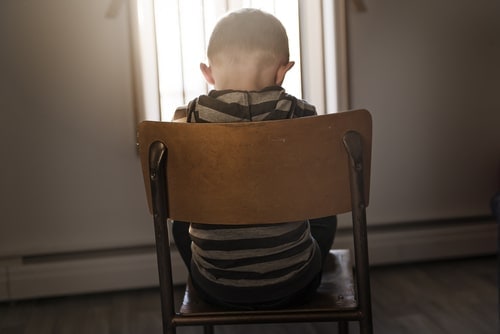
image of boy sitting in chair with back to viewer by shutterstock / Lopolo