Studies suggest we can prevent summer learning loss by engaging kids in reading, math games, and hands-on STEM activities. But the benefits depend on making sure kids are truly stimulated — and having fun!
Here are the details, and tips for creating a rewarding, playful, educational summer.
What is summer learning loss?
Some call it “summer learning loss,” others call it the “summer slide.” But whatever the term you favor, the idea is the same: Without regular practice, new skills and knowledge fade. So many students experience reversals over the extended summer break.
The phenomenon has been documented in a number of countries, including Austria, Germany, New Zealand, the United Kingdom, and the United States (Paechter et al 2015; Meyer et al 2015; Jesson et al 2014; Shinwell and Defeyter 2017).
How much learning is lost? Studies suggest that kids may lose anywhere from 25-50% of their school-year gains in mathematics (Paechter et al 2015; Thum and Hauser 2015; Cooper et al 1996). Or — put another way — the average child may lose more than two months’ worth of mathematical knowledge over the summer.
Children can backtrack in language skills, too, including reading, writing, and spelling (Thum and Hauser 2015; Burgin and Hughes 2008; Shinwell and Defeyter 2017). Younger school children may suffer small setbacks in verbal fluency — i.e., their ability to think of appropriate vocabulary (Rosqvist et al 2020; Kromydas et al 2022).
But overall, losses in reading ability tend to be less dramatic than losses in mathematical ability.
Why? It’s probably a reflection of the “use it or lose it” phenomenon. During the summer, kids continue to engage with language. They are less likely to practice their mathematical skills.
So how do we prevent summer learning loss? How do we stop summer slide?
Some researchers suggest that we make major changes in our schools. They propose lengthening the school year, or replacing the long, summer hiatus with several shorter vacation periods distributed throughout the year.
But we don’t have to wait for such changes to help our children. Nor do we have to turn the summer into a time of regimented, structured learning sessions. Here are some suggestions for making the most of the summer — without sacrificing summer fun.
6 evidence-based tips to prevent summer learning loss
1. Get started on a summer reading program, and make sure your child is reading books that are both interesting and challenging.
Summer reading is important, but it doesn’t always boost skills.
For example, in one study, a summer reading program failed to have any effect on children’s literacy skills. Why? The children who participated got to choose their own books, and they consistently chose books that were too easy for them (Kim and Guryan 2010).
So when selecting books, it’s crucial to make sure you’re child is excited by the content. But you also want reading material that will stretch your child’s skills — introduce some new words and ideas.
Need help finding the right stuff? Visit your local library and talk with the children’s librarian. And if your child is learning the basics, check out this Parenting Science article about the importance of avoiding books with distracting graphics.
2. Set aside some time to review mathematics concepts.
It’s unlikely that most kids will spontaneously practice the sorts of skills that will prevent learning loss in mathematics. And practice really matters. So it’s a good idea to make math review a regular part of your summer.
How much time should you spend? It doesn’t have to be a lot. As I note elsewhere, young school kids can learn new facts from daily sessions of just 5 minutes per day. Imposing longer sessions can, in some cases, be counter-productive. And once learners have encoded new facts, they can improve their long-term retention by taking breaks (of several days or more) between review sessions (Cepeda et al 2008).
What about motivation? Here, we have the help of software developers. There are a number of educational computer games and apps that make practice fun.
For instance, try the free app, Bedtime Math, aimed at kids under the age of 9. It was tested by researchers, and found to be helpful when used by families on an everyday basis (Berkowitz et al 2016).
Or consider the DragonBox math apps. When tested on 7th graders, DragonBox Algebra 12+ helped kids master the concept of algebraic equivalence (Chan, Closser et al 2023). In addition, for those kids who started the study with a good grasp of mathematics, game play was linked with subsequent improvements in math performance (Chan, Byrne et al 2023).
There are DragonBox games for younger children too. For instance, DragonBox Numbers helps children aged 4-8 develop an intuitive understanding of numbers through game play.
You can purchase DragonBox through Amazon, and, if you make a purchase via this link, I will earn a commision from Amazon (at zero cost to you).
3. Play “unplugged” number games to help kids sharpen their math skills.
Research indicates that young children can improve their intuitive understanding of numbers by playing certain board games. And such intuitions really matter: When kids lack a strong grasp of “how much” different numbers really represent, they perform more poorly in school (Mazzococo 2011). You can read more about it (and get instructions for making your own game) here.
In addition, young school children can practice their basic addition and subtraction facts by playing the simple — but excellent — board game, “Sum Swamp.” The game is a race, with players rolling dice and performing quick calculations to determine the number of spaces they must move. You can check the current price by clicking here to view the Sum Swamp game on Amazon. (Once again, I will earn a commision if you make a purchase using that link.)
Finally, I’ve found a number of books for children that help kids visualize mathematical concepts, and some include instructions for mathematical activities and games. See my recommendations in this Parenting Science guide.
4. Develop spatial skills through spatial rotation games and construction play
Experiments demonstrate that we can hone strong spatial skills through practice, and better spatial reasoning leads to enhanced performance in math and science.
For example, when young school children were asked to practice mental rotation tasks – tasks that required them to predict how two geometrical shapes would look when stuck together – these kids went on to show improvements in their ability to solve basic algebra problems (Cheng and Mix 2012).
For ideas on how to encourage spatial play, see my evidence-based articles about tangrams, blocks, and other activities for boosting a child’s spatial skills.
5. Take trips to museums, zoos, and nature sites. But don’t merely attend. Help children enjoy hands-on experiences, and engage in family conversations.
Kids learn more from museum experiences when they engage in hands-on activities. They also benefit when parents ask them to interpret what they see.
For example, in one study, kids visiting an anthropological exhibit learned more when their parents asked them open-ended questions about the artifacts they encountered (Jant et al 2014).
What do you think this tool was used for? What do you think it is made of? How do you think it would feel to sleep on this mat?
In another museum-learning study, preschoolers showed more spontaneous focus on numbers and counting after their parents had engaged them in playful number talk and counting games (Braham et al 2018). How many dinosaurs are here? Let’s count together.
And after you leave? Help kids consolidate what they’ve learned by asking kids what they remember.
As I explain elsewhere, one of the best ways is to encourage children to explain what they have learned. And a recent study reports links between parent-child conversations and retention: The more kids talked about a science lesson with their parents, the more they remembered later on (Leitchman et al 2017).
To learn more about the fascinating effects of explaining things to others, read my article, “How kids learn math and science: Stimulate learning by asking kids to explain.”
6. Choose STEM summer camps that emphasize informal, hands-on learning.
Research suggests that summer camps in STEM (science, technology, engineering, and mathematics) can stoke children’s interest in STEM fields.
What makes a great program? Hands-on, activity-based STEM activities — like building, coding, robotics, or science labs — that allow kids to tinker and solve problems themselves. This isn’t the time for lectures and passively sitting by. Kids learn by doing (Roberts et al 2018).
To find an informal summer learning program near you, look online, and try contacting local schools, public libraries, museums, and zoos. Are the options too pricey? Don’t assume you’ll have to pay. Ask about free and low-cost programs.
7. Can’t find an affordable summer camp? Create your own.
The nonprofit organization Reading Rockets offers materials for a 5-day DIY program called “River Rangers,” which helps kids learn about everything from the formation of rivers, to riverine ecosystems and the management of human drinking water. You can access these free materials, and other ideas to battle summer learning loss, here.
In addition, you will find links to many educational resources in my article, “Suddenly homeschooling? Here’s help for getting started.” And if you’re looking for ideas for preschool science activities, see these Parenting Science pages.
8. Let kids explore interests that don’t fit into the standard, school-year curriculum
This is my personal suggestion, but it’s consistent with experiments: Personal curiosity is a major driver of learning (Gruber et al 2014).
How many students have been bored by school, and then–one lucky day–they discovered an academic subject they were really passionate about?
Such discoveries can change lives, but many people never make them. When I was a child, extended summer breaks were a chance to indulge my curiosity about all sorts of things that never made it into the standard school curriculum–paleontology, astronomy, rock collecting, the geology of Mars, the search for extraterrestrial life, ancient history.
How would I have turned out without these opportunities? I don’t know, but I’m sure I would have been worse off. And for some kids, these extracurricular investigations lead to big things. Astrophysicist Neil deGrasse Tyson traces the beginnings of his career to childhood experiences with a telescope.
Looking for some interesting topics? Here are some suggestions:
Animal behavior. David Attenborough has produced many outstanding educational programs about animals. These, combined with reading and hands-on activities can help your child develop a lifelong interest in biology. What to do? Get kids outside, and show them how to locate wildlife. See these Parenting Science tracking activities for more information, and don’t forget to let your child photograph what he or she sees. Nature photography doesn’t just help kids document their discoveries. It also encourages them to learn stealth and patience!
Computer programming. Researchers at MIT have developed a visual programming environment called Scratch. It permits kids to learn computer programming concepts — and create coded projects — even before they learn to read. Best of all, it’s free to use. All you need is a computer with an internet connection.
Dinosaurs. See my guide to resources about paleontology and dinosaurs for kids.
Space exploration. In additional to finding books on the subject, check out the local planetarium. In addition, don’t miss NASA’s interactive website for kids.
More ideas? See my recommended children’s books.
References: Summer learning loss
Bell SR and Carrillo N. 2007. Characteristics of Effective Summer Learning Programs in Practice. New Directions for Youth Development 114: 45-63.
Berkowitz T, Schaeffer MW, Maloney EA, Peterson L, Gregor C, Levine SC, Beilock SL. 2015. Math at home adds up to achievement in school. Science 350 (6257): 196-198.
Braham EJ, Libertus ME, McCrink K. 2018. Children’s spontaneous focus on number before and after guided parent-child interactions in a children’s museum. Dev Psychol. 54(8):1492-1498.
Burgin JS and Hughes GD. 2008. Measuring the Effectiveness of a Summer Literacy Program for Elementary Students Using Writing Samples. Research in the Schools, 15(2): 55–64.
Cepeda NJ, Vul E, Rohrer D, Wixted JT, and Pashler H. 2008. Spacing effects in learning: a temporal ridgeline of optimal retention. Psychol Science 19(11):1095-102.
Chan J Y-C, Byrne C, Jerusal J, Liu AS, Roberts J, Ottmar E. 2023. Keep DRAGging ON: Is solving more problems in DragonBox 12+ associated with higher mathematical performance during the COVID-19 pandemic? British Journal of Education Technology. Published online ahead of print 15 Feb 2023: https://doi.org/10.1111/bjet.13304
Chan J Y-C, Closser AH, Vy Ngo V, Smith H, Liu AS, and Ottmar E. 2023. Examining shifts in conceptual knowledge, procedural knowledge and procedural flexibility in the context of two game-based technologies. Journal of Computer Assisted Learning Published online ahead of print 03 March 2023: https://doi.org/10.1111/jcal.12798
Cheng Y-L and Mix KS. 2012. Spatial training improves children’s mathematics ability. Journal of Cognition and Development. 15: 2-11.
Connor CM, Morrison FJ, Fishman B, Crowe EC, Al Otaiba S, and Schatschneider C. 2013. A Longitudinal Cluster-Randomized Controlled Study on the Accumulating Effects of Individualized Literacy Instruction on Students’ Reading From First Through Third Grade. Psychological Science 24(8): 1408–1419.
Cooper H, Nye B, Charlton K, Lindsay J, and Greathouse S. 1996. The effects of summer vacation on achievement test scores: A narrative and metaanalytic review. Review of Educational Research 66: 227–268.
Jant EA, Haden CA, Uttal DH, Babcock E. 2014. Conversation and Object Manipulation Influence Children’s Learning in a Museum. Child Dev. 85(5):2029-45.
Jesson R, McNaughton S, and Kolose T. 2014. Investigating the summer learning effect in low SES schools. Australian Journal of Language and Literacy. 37(1): 45–54.
Kim JS and Guryan J. 2010. The efficacy of a voluntary summer book reading intervention for low-income Latino children from language minority families. Journal of Educational Psychology, Vol 102(1): 20-31.
Kraft MA, and Monti-Nussbaum M. 2017. Can schools enable parents to prevent summer learning loss? A text messaging field experiment to promote literacy skills. The ANNALS of the American Academy of Political and Social Science [Internet]. 674 (1) :85-112.
Kromydas T, Campbell M, Chambers S, Boon MH, Pearce A, Wells V, Craig P. 2022. The effect of school summer holidays on inequalities in children and young people’s mental health and cognitive ability in the UK using data from the millennium cohort study. BMC Public Health. 22(1):154.
Leichtman MD, Camilleri KA, Pillemer DB, Amato-Wierda CC, Hogan JE, Dongo MD. 2017. Talking after school: Parents’ conversational styles and children’s memory for a science lesson. J Exp Child Psychol. 156:1-15.
Mazzocco MM, Feigenson L, Halberda J. 2011. Impaired Acuity of the Approximate Number System Underlies Mathematical Learning Disability (Dyscalculia). Child Dev. 82(4): 1224-12377.
Meyer F, Meissel K, McNaughton S. 2015. Patterns of literacy learning in German primary schools over the summer and the influence of home literacy practices. J Res Read 40:1–21.
Paechter M, Luttenberger S, Macher D, Berding F, Papousek I, Weiss EM, and Fink A. 2015. The effects of nine-week summer vacation: losses in mathematics and gains in reading. EURASIA J Math Sci Technol Educ 11(6):1339–413.
Roberts T, Jackson C, Mohr-Schroeder MJ, Bush SB, Maiorca C, Cavalcanti M, Craig Schroeder D, Delaney A, Putnam L, Cremeans C. 2018. Students’ perceptions of STEM learning after participating in a summer informal learning experience. Int J STEM Educ. 5(1):35.
Rosqvist I, Sandgren O, Andersson K, Hansson K, Lyberg-Åhlander V, Sahlén B. 2020. Children’s development of semantic verbal fluency during summer vacation versus during formal schooling. Logoped Phoniatr Vocol. 45(3):134-142.
Sandberg Patton KL and Reschly AL. 2013. Using Curriculum-Based Measurement to Examine Summer Learning Loss. Psychology in the Schools 50(7): 738-753
Shinwell J and Defeyter MA. 2017. Investigation of Summer Learning Loss in the UK-Implications for Holiday Club Provision. Front Public Health. 5:270.
Thum YM and Hauser CH. 2015. NWEA 2015 MAP Norms for Student and School Achievement Status and Growth. NWEA Research Report. Portland, OR: NWEA
Written content of “Preventing Summer Learning Loss” last modified 5/2023. Portions of the text derive from previous versions of this article, written by the same author.
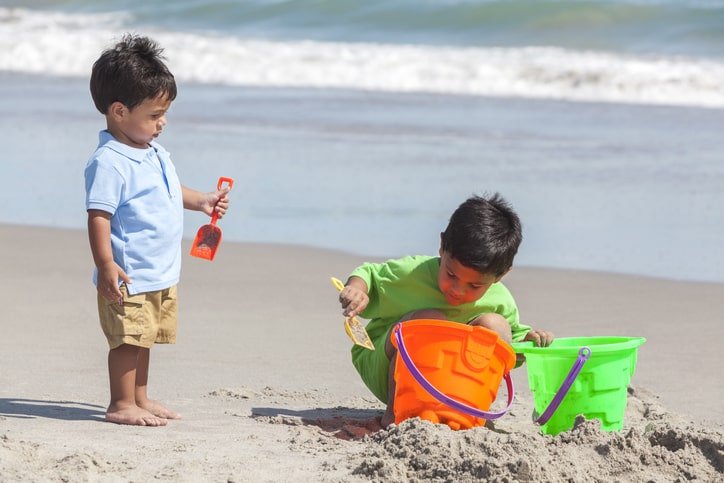
Image of boys on beach by istock/ Spotmatik