Teaching self-control? Studies confirm that it’s possible. Kids benefit when we remove temptations and distractions, and create environments that reward self-restraint. Kids also need timely reminders to stay on track, and concrete, practical advice for staying motivated, overcoming obstacles, and sticking to a plan.
Here is the background, and 12 tips for making it happen.
What is self-control, and how much does it matter?
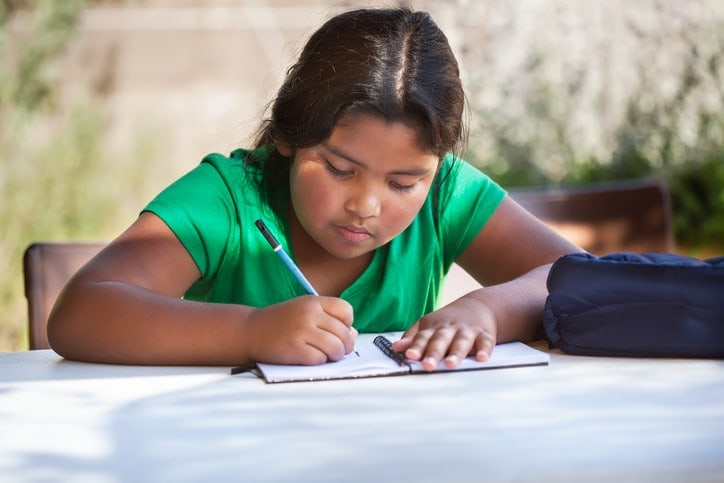
Self-control has been defined in many ways–as willpower, self-discipline, or conscientiousness. But however you define it, self-control is about being able to regulate yourself.
Can a child resist distractions? Inhibit impulses? Bounce back from difficult emotions? Delay gratification and plan ahead?
Obviously, a lot depends on the child’s age. Toddlers lack the self-control of older kids. Self-control develops over the years, with some of the biggest changes happening between the ages of 3 and 7. But there is a lot of individual variation too. Some kids have more trouble regulating themselves, and they suffer for it.
Young children with poor self-regulation skills tend to make less academic progress (McClelland et al 2007; Welsh et al 2010; McClelland et al 2014). Throughout the school years, they are more likely to experience anxiety, depression, and aggressive behavior problems (Martel et al 2007; Eisenberg et al 2010; Raaijmakers et al 2008; Ellis et al 2009).
In the long run, kids with poor self-control are at higher risk for poor health outcomes, like obesity and drug dependency (Sutin et al 2011; Moffit et al 2011). They are more likely to commit crimes and less likely to become wealthy (Moffit et al 2011).
So how do we foster self-discipline in children?
Some people will tell you that we can’t — that it’s “all in the genes.” But the science doesn’t support this claim. Studies suggest that genes play a role in shaping the development of self-regulation (Reif et al 2009; Smith et al 2009). But do parents and teachers. In fact, we can have a major impact on the way our kids behave. Here’s how.
12 tips for teaching self-control
1. Help kids avoid temptation: Out of sight, out of mind
High-functioning adults have been known to lose their will-power at the sight of a doughnut. So one of the most important tools for maintaining self-control is to change the environment (Duckworth et al 2016). Keep temptations hidden!
For young children, this might mean putting away a toy that is likely to cause conflict during a playdate; or avoiding the sweets aisle of the grocery store when you are shopping together.
For older children, it might mean keeping electronic distractions away from areas where children do homework. But you can go further with older kids: Teach them how to identify temptations on their own, and take the necessary action to eliminate them.
Kids who stay out of trouble — and achieve more — aren’t necessarily blessed with greater strength of character. They’re better at anticipating and avoiding situations that trigger impulsive behavior.
2. Create an environment where self-control is consistently rewarded
You may have heard of the famous “marshmallow test.” Preschoolers were given the choice between eating one treat now or two treats later, and the kids who demonstrated the greatest capacity to wait ended up, in subsequent years, with better outcomes.
They performed better on scholastic achievement tests, were more likely to finish college, and less likely to develop substance abuse problems.
But when Celeste Kidd revisited this research, she wondered how much depended on a child’s expectations. If experience has taught you that adults don’t keep their promises, or that institutions don’t enforce the fair allocations of rewards, why should you wait patiently for a hypothetical prize?
Kidd tested her idea in a landmark experiment (which I detail here), and the results bore her out. It only took a couple of disappointments to undermine children’s willingness to delay gratification (Kidd et al 2011).
Subsequent studies confirm that our willingness to wait depends on how we weigh the risks and benefits. Adults opt for immediate gratification when they have reason to distrust the person promising to deliver a future prize (Michaelson et al 2013). And even two-year-olds have resisted the temptation of cookie – when the rewards for waiting were sufficiently high (Steelandt et al 2012).
3. Support young children with timely reminders
It’s hard to stick with the program if you don’t remember the rules, and young children have more trouble keeping our directions in mind. They are easily distracted. So it’s helpful to remind young children about our expectations.
In experiments by Jane Barker and Yuko Munakata (2015), three-year-olds were asked to perform a simple task requiring impulse control:
Open a box to get a prize, but after you’ve been given the correct signal. If you see a blue square, that means go ahead. A red triangle means leave the box alone.
What’s the best way to coach children for such a task? The researchers tested two different approaches, and found that one was clearly superior. When an adult reminded children of the rules just before each trial, kids were more likely to check their impulses. By contrast, giving children a few seconds to stop and think — without any reminder — had no such effect.
4. Play games that help preschoolers practice self-control
Any time we ask kids to play by the rules, we’re encouraging them to develop self-control. But some games are more challenging than others.
For instance, take the traditional game, “Red light, Green light.” When a child hears the words “Green light!” she’s supposed to move forward. When she hears “Red light!” she must freeze.
In this classic form, the game is about following directions. But with a twist, it gets trickier:
After the kids have adjusted to the rules, reverse them. Make “Red light!” the cue to go and “Green light!” the cue to stop.
Now the game tests a child’s ability to go against habit. She must inhibit her impulses, practicing what psychologists call “self-regulation.”
Do such games help? That’s what researchers Shauna Tominey and Megan McClelland wanted to know. So they measured the self-regulation skills of 65 preschool children living in the United States, and then randomly assigned half of them to participate in a series of game sessions (Tominey and McClelland 2009).
The game sessions featured the modified version of “Red Light, Green Light” and other games designed to give kids a self-regulation workout:
- The Freeze game. Kids dance when the music plays and freeze when it stops. Dance quickly for fast-tempo songs, slowly for slow-tempo songs. And then reverse the cues: Fast music = slow dancing. Slow music = fast dancing.
- Color-matching freeze. In this variant of the freeze game, kids don’t just stop dancing when the music stops. First, they find a colored mat and stand on it. Then, before they freeze, they perform a special dance step. There are several, differently-colored mats on the floor, and each color is linked with a different dance step.
- Conducting an orchestra. Kids play musical instruments (like maracas and bells) whenever an adult waves her baton, increasing their tempo when the baton moves quickly and reducing their tempo when the baton slows down. Then the opposite rules apply (e.g., kids play faster when the baton moves slowly).
- Drum beats. A teacher tells kids to respond to different drum cues with specific body movements. For example, kids might hop when they hear a fast drum beat and crawl when they hear a slow drum beat. After a time, kids are asked to reverse the cues.
The kids played these games twice weekly is sessions of thirty minutes each, and after eight weeks, the researchers re-assessed the children’s self-regulation abilities.
Kids who began the program with above-average self-control showed no improvements, but the story was different for children who had been struggling. Preschoolers who started with low self-regulation scores (below the 50th percentile) had gotten better.
In subsequent studies, researchers have obtained similar results, albeit with small effect sizes that weren’t always statistically significant (McClelland et al 2019). When researchers performed a cost-benefit analysis of the most effective way to deliver improvements, they found that the best approach is to have research assistants train preschool teachers in the proper use of these games (Li et al 2021).
Other researchers have tested a fantasy-themed program of games on 5-year-old school children in Italy.
Three times a week, kids pretended they were helping a couple of hapless goblins by performing “magical tasks.” For instance, one game asked kids to listen carefully to a story about the travels of an elephant, and then recreate his route by putting representative toys in the correct spatial order.
Other activities resembled traditional games like “Red Light, Green Light” (e.g., asking kids to either jump or stop according to rules that shift over of the course of the game). And kids were frequently required to coordinate their behavior, as when each child had to remember and locate a different ingredient for a magic potion they were making.
Overall, the games were designed to reinforce inhibition, shifting between rules, and working memory (see item #7 below). And they seemed to work. After four weeks, the kids outperformed control group peers in a variety of tests, including tests of impulse control, cognitive flexibility, and working memory (Traverso et al 2015; Traverso et al 2019).
For details, see the original paper and download the “additional data file” to read about the specific games used.
5. Give kids a break
Kids benefit when we allow them downtime — breaks from following directions and working hard. Why? Studies show that people don’t maintain the same levels of self-control over time. If you give them two, demanding tasks to complete — one immediately after the other — people usually show less self-control during the second task.
There are at least two possible reasons for this. One popular account is that self-control gets used up during the day. We literally lack the energy to keep going.
Another account, proposed by Michael Inzlicht and his colleagues (2014), is that our brains are designed to seek a kind of balance between drudgery and seeking out easy rewards.
A creature who sticks with the same old work routine, never taking a break, is apt to miss important changes in the environment. By taking time out to play and explore, we increase our chances of discovering profitable new opportunities.
Whichever account is correct, the upshot is the same: If you ask a child to go straight from one unpleasant duty to the next, self-control is likely to suffer.
Giving kids a break can help them re-charge, and it’s also a good way to learn. Studies suggest that kids learn faster when lessons are shorter and separated by some downtime (Seabrook et al 2005). For more information, see my article about “spaced learning.”
6. Encourage preschoolers to engage in cooperative, pretend play
When we talk about improving children’s self-control, games of “make-believe” might not immediately come to mind. But if you think about it, playing games of pretend with other people requires a lot of self-regulation. You need to keep track of the informal rules of play, and inhibit your normal reactions (e.g., “this isn’t the sofa, it’s the cockpit of our spacecraft…”). You must pay attention to what your playmates are adding to the scenario, so you can keep up. You need to focus on your choices, and be careful about maintaining the pretense.
These are skills that contribute to self-control, and there is reason to think preschoolers can improve them if they engage in regular, cooperative, make-believe activities. In experiments, kids who engaged in guided, cooperative, pretend play showed subsequent enhancements in certain self-regulatory skills, such as the ability to repress their natural impulses in order to get a reward (White and Carlson 2021; Thibodeau et al 2016).
7. Be aware of the links between screen time and poor self-regulation skills
When researchers track young children over time, they keep seeing the same, worrying pattern: The more time kids spend in front of screens, the worse they tend to perform on subsequent tests of self-control. For example, in one study, 2-year-olds who spent more time engaging with televisions and touch-screens ended up – one year later – with lower scores on tests requiring focus, concentration, and inhibitory control (McHarg et al 2020).
Why does this happen? In part, it might be that screen time displaces other activities – activities that help kids hone their self-regulation skills. It also appears that the type of content matters. Kids may be at less risk if they consume only age-appropriate, educational programs. But note that even background TV seems to contribute to the problem (e.g., Portugal et al 2022), and – overall – kids who meet current screen time recommendations from the American Academy of Pediatrics (less than 60 minutes per day) display better self-regulation (McMath et al 2023).
8. Turn “must do” tasks into “want to” tasks
A student who won’t cooperate in the classroom might seem like the poster child for poor self-regulation. But give him his favorite set of Legos or a beloved video game, and he’s all focus, persistence, and drive.
He doesn’t lack self-control. He lacks motivation. He needs to find enjoyment in the things he’s asked to do, and that’s where he needs our help.
Savvy adults know how to get psyched up for an assignment – how to find ways to get personally interested, or to combine work with a bit of pleasure. They also know that approaching a task as if it’s a nasty chore always makes things worse, even if it is, in fact, a nasty chore.
But children have a hard time figuring all this out, especially if adults are themselves modeling the wrong attitude.
Turning a chore into a game takes time and energy. Discovering the right hooks to get kids interested may require a lot of patience, observation, and flexibility. But as many successful teachers and therapists know, it’s an investment that pays off.
And it may be the key to beating “self control fatigue” (Inzlicht et al 2014). It’s much easier to plow through a pile of homework when you’ve learned to find at least some of it enjoyable.
9. Instill the right mindset for tackling challenges and learning from failure
Many people think of intelligence and talent as “gifts” that we inherit and can’t improve upon. When these people fail, they feel helpless and give up.
By contrast, people who believe that effort shapes intelligence and talent are more resilient. As I explain elsewhere, they are more likely to take on challenges and learn from their mistakes.
We can help kids develop this sort of resilience and determination by being careful with our feedback. Experiments show that praising kids for general traits (“You’re so smart!”) makes them adopt the wrong mindset. So does general criticism (“I’m disappointed in you”).
What works better is praise for effort, and feedback that encourages kids to try different strategies (“Can you think of another way to do it?”)
For more information, see my articles about praise and intelligence and the best way to counteract helplessness in children.
10. Help children develop their attention and working memory skills
Even if you have the right mindset, it can be hard to follow through. What if you have trouble staying on task? Paying attention? Remembering what you’re supposed to do next?
Many distracted, impulsive kids suffer from low working memory capacity. That’s the mental workspace or notepad we use to keep information “in mind.” When you are trying to solve a math problem…or trying to remember those verbal directions to the post office…you are using working memory.
Young children don’t perform as well as adults on working memory tasks. That’s normal. But some kids struggle more than others, and while there is no single, magic cure-all for working memory deficits, there are many things we can do to help. For more information, see these evidence-based tips for enhancing working memory performance in children.
11. Be an “emotion coach”
Adults react in different ways to a child’s negative emotions. Some are dismissive (“That’s no reason to be sad.”). Others are disapproving (“Stop crying!”)
These approaches aren’t helpful, because they don’t teach kids how to regulate themselves.
By contrast, kids benefit when parents talk to them about their feelings, show empathy, and discuss constructive ways to cope.
Researchers call this “emotion coaching,” and it’s associated with better child outcomes. For instance, in one recent study, adolescents who had been coached by their mothers showed a pattern of decreasing behavior problems over time (Shortt et al 2010).
What’s the best way to proceed? See these evidence-based tips for being an effective emotion coach. For additional information about the benefits of talking with kids about their emotions, see this article on mind-minded parenting.
12. Encourage children to practice planning
Planning is an important component of self-discipline. People are more likely to succeed when they think about the obstacles they face, and come up with specific steps about when, where, and how they will take action (Duckworth et al 2019).
Can we teach kids to plan? I haven’t seen any experiments testing the idea. But everyday experience suggests that practice is helpful, and research offers relevant insights.
Merely reminding people to plan ahead can improve their performance on certain puzzle-like tasks.
In experiments on kids (Lidstone et al 2010) and adults (Unterrainer et al 2006), people didn’t always plan ahead when they tackled a problem. But they changed their approach–and often had more success–after they were explicitly instructed to think before tacking action.
Some games reward players for planning ahead, and these games might teach lessons that kids will apply to other situations.
In one study, researchers asked people to work on a standard planning task called the Tower of London. Some people were experienced chess players, others were not.
The chess players were no more intelligent than their peers, but they showed better planning skills and spent more time planning their moves (Unterrainer et al 2006). Does chess teach kids to plan ahead? Maybe.
Kids can benefit from “self-talk.”
Ever solved a problem by talking to yourself? Research suggests that our ability to plan depends, in part, on our verbal abilities.
In one experiment, researchers asked kids to work on the Tower of London task without “thinking out loud.” The imposed silence hurt their performance, most likely because it interfered with their ability to create and follow a plan (Lidstone et al 2010).
Another study found that preschoolers who used words to describe time (like “soon” or “later”) were better at delaying gratification (Kumst and Scarf 2015). Perhaps they could better explain to themselves the advantages of waiting for a larger reward.
13. Take stock of the way you handle misbehavior
Many researchers suspect that parenting styles have an influence on the development of self-control.
For instance, a study of American preschoolers (Piotrowski et al 2013) found that kids were more likely to exhibit poor self-regulation skills if they had parents who agreed with statements like
- “I ignore my child’s bad behavior,” and
- “I give in to my child when he/she causes a commotion about something.”
Other research suggests that permissive parenting during middle childhood puts kids at greater risk for social aggression (Ehrenreich et al 2014). It makes sense. How do you develop self-restraint if nobody ever asks you to practice it?
But it seems likely that parents can also go too far in the other direction.
In the preschool study, kids with parents who took an “obey me without question” approach weren’t as badly behaved as were children with permissive parents. But they were still lacking in self-regulation skills.
Other research suggests that corporal punishment–when used as a routine method of control–may interfere with the development of self-regulation. It may also encourage children to tell lies. Read more about it in my articles on authoritarian parenting and spanking.
14. Remember that kids need autonomy
All around the world, kids experience similar feelings about adult authority. They are ready to cooperate with some of our rules and requests. But there are limits.
Kids are more likely to rebel when they perceive us meddling in their personal business (like telling them what to wear, or insisting that they engage in a particular recreational activity).
Adults can try to get bossy, but if kids think we’re overreaching, they will conclude that our authority is illegitimate.
They might respond with open defiance. Or they might sneak behind our backs. But either way, their failure to cooperate doesn’t mean they lack self-control.
Kids are making a considered judgement: They believe they have the right to resist.
So if you seem to be locked in a battle of wills, it’s helpful to consider your child’s needs for autonomy. If you talk with your child, and consider his or her perspective, you may find ways to adjust your demands, and inspire more cooperation.
Read more about it in my article, “Why kids rebel: What kids believe about the legitimacy of adult authority.”
More information
For more information about teaching self-control, see this guide to positive parenting. In addition, these evidence-based tips are designed to help you cope with behavior problems that are often related to poor self-regulation. And if you’re looking for ways to keep your toddler calm and collected, see my article, “How to distract a 2-year-old (to avoid an emotional meltdown)”.
References: Teaching self-control
Barker JE and Munakata Y. 2015. Time isn’t of the essence: Activating goals rather than Imposing delays improves inhibitory control in children. Psychol Sci. 26(12):1898-908.
Duckworth AL, Gendler TS, Gross JJ. 2016. Situational Strategies for Self-Control. Perspect Psychol Sci. 11(1):35-55.
Duckworth AL, Milkman KL, Laibson D.. 2018. Beyond Willpower: Strategies for Reducing Failures of Self-Control. Psychol Sci Public Interest. 19(3):102-129.
Ehrenreich SE, Beron KJ, Brinkley DY, and Underwood MK. 2014. Family predictors of continuity and change in social and physical aggression from ages 9 to 18. Aggress Behav. 40(5):421-39.
Eisenberg N, Spinrad TL, and Eggum ND. 2010. Emotion-related self-regulation and its relation to children’s maladjustment. Annu Rev Clin Psychol. 6:495-525.
Helm AF and McDermott JM. 2022. Impact of tablet use on young children’s inhibitory control and error monitoring. J Exp Child Psychol. 222:105446.
Imuta K, Hayne H, and Scarf D. 2014. I want it all and I want it now: Delay of gratification in preschool children. Dev Psychobiol. 56(7):1541-52.
Inzlicht M, Schmeichel BJ, Macrae CN. 2014. Why self-control seems (but may not be) limited. Trends Cogn Sci. 18(3):127-33.
Kern ML, Friedman HS, Martin LR, Reynolds CA, and Luong G. 2009. Conscientiousness, career success, and longevity: a lifespan analysis. Ann Behav Med. 37(2):154-63.
Kiff CJ, Lengua LJ, and Bush NR. 2011. Temperament Variation in Sensitivity to Parenting: Predicting Changes in Depression and Anxiety. J Abnorm Child Psychol. 39(8):1199-212.
Kumst S and Scarf D. 2015. Your wish is my command! The influence of symbolic modelling on preschool children’s delay of gratification. Peer J. 3:e774.
Janssens JMAM and Dekovic M. 1997. Child Rearing, Prosocial Moral Reasoning, and Prosocial Behaviour. International Journal of Behavioral Development 20(3): 509-527.
Kidd C, Palmeri H, and Aslen RN. 2011. Rational snacking: Young children’s decision-making on the marshmallow task is moderated by beliefs about environmental reliability. Cognition 126(1): 109-114.
Li T, McClelland MM, Tominey SL, Tracy A. 2021. Cost-Effectiveness Analyses on Various Models of The Red Light, Purple Light Self-Regulation Intervention for Young Children. Front Psychol. 12:711578.
Lidstone JS, Meins E, and Fernyhough C. 2010. The roles of private speech and inner speech in planning during middle childhood: evidence from a dual task paradigm. J Exp Child Psychol. 107(4):438-51. Epub 2010 Jul 14.
Martel MM, Nigg JT, Wong MM, Fitzgerald HE, Jester JM, Puttler LI, Glass JM, Adams KM, and Zucker RA. Childhood and adolescent resiliency, regulation, and executive functioning in relation to adolescent problems and competence in a high-risk sample. 2007. Dev Psychopathol. 19(2):541-63.
McClelland MM, Tominey SL, Schmitt SA, Hatfield BE, Purpura DJ, Gonzales CR, Tracy AN. 2019. Red Light, Purple Light! Results of an Intervention to Promote School Readiness for Children From Low-Income Backgrounds. Front Psychol. 10:2365.
McClelland MM, Cameron CE, Duncan R, Bowles RP, Acock AC, Miao A, Pratt ME. 2014. Predictors of early growth in academic achievement: the head-toes-knees-shoulders task. Front Psychol. 5:599.
McHarg G, Ribner AD, Devine RT, Hughes C. 2020. Screen Time and Executive Function in Toddlerhood: A Longitudinal Study. Front Psychol. 11:570392.
McMath AL, Iwinski S, Shen S, Bost KF, Donovan SM, Khan NA. 2023. Adherence to Screen Time and Physical Activity Guidelines is Associated with Executive Function in US Toddlers Participating in the STRONG Kids 2 Birth Cohort Study. J Pediatr. 252:22-30.e6.
Michaelson L, de la Vega A, Chatham CH, and Munakata Y. 2013. Delaying gratification depends on social trust. Front Psychol. 4: 355.
Moffitt TE, Arseneault L, Belsky D, Dickson N, Hancox RJ, Harrington H, Houts R, Poulton R, Roberts BW, Ross S, Sears MR, Thomson WM, Caspi A. 2011. A gradient of childhood self-control predicts health, wealth, and public safety. Proc Natl Acad Sci U S A. 108(7):2693-8.
Moreno, S., Bialystok, E., Barac, R., Schellenberg, E. G., Cepeda, N. J., & Chau, T. 2011. Short-term music training enhances verbal intelligence and executive function. Psychological Science. 22(11): 1425-1433.
Portugal AM, Hendry A, Smith TJ, Bedford R. 2023. Do pre-schoolers with high touchscreen use show executive function differences?. Comput Human Behav. 139:107553.
Raaijmakers MA, Smidts DP, Sergeant JA, Maassen GH, Posthumus JA, van Engeland H, Matthys W. 2009. Executive functions in preschool children with aggressive behavior: impairments in inhibitory control. J Abnorm Child Psychol. 36(7):1097-107.
Reif A, Jacob CP, Rujescu D, Herterich S, Lang S, Gutknecht L, Baehne CG, Strobel A, et al. 2009. Influence of Functional Variant of Neuronal Nitric Oxide Synthase on Impulsive Behaviors in Humans. Archives of General Psychiatry, 66 (1): 41-50.
Rhee SH, Friedman NP, Smith Watts AK, Corley RP, Hewitt JK, Robinson J, Zahn-Waxler C. 2018. The Association Between Toddlerhood Self-Control and Later Externalizing Problems. Behav Genet.;48(2):125-134.
Seabrook R, Brown G.D.A., and Solity JE. 2005. Distributed and massed practice: from laboratory to classroom. Applied Cognitive Psychology 19(1): 107-122.
Shortt JW, Stoolmiller M, Smith-Shine JN, Mark Eddy J, and Sheeber L. 2010. Maternal emotion coaching, adolescent anger regulation, and siblings’ externalizing symptoms. J Child Psychol Psychiatry. 51(7):799-808.
Smith AK, Mick E, and Faraone SV. 2009. Advances in genetic studies of attention-deficit/hyperactivity disorder. Curr Psychiatry Rep.11(2):143-8.
Steelandt S, Thierry B, Broihanne MH, and Dufour V. 2012. The ability of children to delay gratification in an exchange task. Cognition.122(3):416-25.
Sutin AR, Ferrucci L, Zonderman AB, and Terracciano A. 2011. Personality and obesity across the adult life span. Journal of Personality and Social Psychology. 101(3):579-92
Thibodeau RB, Gilpin AT, Brown MM, Meyer BA. 2016. The effects of fantastical pretend-play on the development of executive functions: An intervention study. J Exp Child Psychol. 145:120-38.
Tominey S and McClelland M. 2011. Red Light, Purple Light: Findings From a Randomized Trial Using Circle Time Games to Improve Behavioral Self-Regulation in Preschool. Early Education & Development 22(3): 489-519.
Traverso L, Viterbori P, Usai MC. 2019. Effectiveness of an Executive Function Training in Italian Preschool Educational Services and Far Transfer Effects to Pre-academic Skills. Front Psychol. 10:2053
Traverso L, Viterbori P, Usai MC. 2015. Improving executive function in childhood: evaluation of a training intervention for 5-year-old children. Front Psychol. 6:525.
Unterrainer JM, Kaller CP, Halsband U, Rahm B. 2006. Planning abilities and chess: a comparison of chess and non-chess players on the Tower of London task. Br J Psychol. 97 (Pt 3):299-311.
Wacker S and Roebers CM. 2022. Stop and think: Additional time supports monitoring processes in young children. PLoS One. 17(9):e0274460.
Wanless SB, McClelland MM, Acock AC, Ponitz CC, Son SH, Lan X, Morrison FJ, Chen JL, Chen FM, Lee K, Sung M, and Li S. 2011. Measuring behavioral regulation in four societies. Psychol Assess. 23(2):364-78.
Welsh JA, Nix RL, Blair C, Bierman KL, Nelson KE. 2010. The Development of Cognitive Skills and Gains in Academic School Readiness for Children from Low-Income Families. J Educ Psychol. 102(1):43-53.
White RE and Carlson SM. 2021. Pretending with realistic and fantastical stories facilitates executive function in 3-year-old children. J Exp Child Psychol. 207:105090.
Content of “Teaching self-control” last modified 11/2023
Title image of child writing by mmg1design / istock