Toy blocks, also called “building blocks,” are solid shapes used for construction play. Some are simple planks made of wood. Others are fancier, like the interlocking bricks of plastic made by LEGO ® and MEGA Bloks®. But whatever form they take, blocks can function as powerful learning tools.
Studies suggest that construction toys can help children develop
- motor skills and hand-eye coordination,
- spatial reasoning,
- cognitive flexibility,
- language skills,
- a capacity for creative, divergent thinking,
- social competence, and
- engineering skills.
There is also evidence that complex block-play is linked with higher mathematical achievement.
How does it all happen? It’s easy to see how stacking and arranging toy blocks could stimulate a young child’s motor development. But for other skills, it’s likely that kids need to do more than simply move blocks around. Research suggests that children benefit when construction play incorporates additional elements, including:
- building from templates,
- engaging in cooperative projects, and
- talking with others about spatial relationships.
Here is a review of the evidence, with some tips for enriching block play.
Babies – even young infants – can hone their motor skills by playing with blocks
Can infants play with blocks? Yes! But, as you would expect, block play takes different forms depending on a child’s age and developmental level. Babies as young as 6 months may enjoy grasping and handling blocks, but the most fundamental activity required to build with blocks – stacking – doesn’t emerge until later.
In a study tracking the development of 37 babies over time, only 16% of 10-month-olds were observed stacking one item on top of another. By 12 months, approximately 45% had reached this milestone, and a few infants were stacking two or more items. By 14 months? Most babies were stacking, and 38% could build structures by stacking two or more pieces (forming a three-component “tower”). But 13% of 14-month-olds weren’t seen stacking at all (Marcinowski et al 2019).
What are babies learning during these early experiences with block play?
They are honing fine motor skills — improving their ability to grasp and manipulate. They are also developing hand-eye coordination, which includes learning to control the speed with which they reach and move their hands, so that they will eventually be capable of slowing down as they place one block on top of another. Such coordination will be crucial for building taller towers (think of the game, “Jenga”), as well as for creating “bridges,” where two columns are topped by a cross-piece.
At what age can a child stack 6 blocks?
By the age of 24 months, most children are capable of stacking 6 blocks or more, but this ability is rooted in previous experience (Marcinowski et al 2019). To become a proficient builder, your baby needs lots of practice! So it makes sense to provide your child with blocks at an early age.
Make sure they are nontoxic and baby-safe, and your infant can investigate the tactile and visual properties of blocks — handling, shaking, tossing, sorting, and carrying them. Your baby might also enjoy knocking down towers that you build, and this, too, is a valuable learning experience!
Toy blocks promote better spatial reasoning
We know there are links between spatial skills and construction play. For example, when Yvonne Caldera and her colleagues observed the construction activities of 51 preschoolers, they discovered a pattern: The kids who showed more interest in construction — and built more complex structures — performed better on a standardized test of spatial intelligence (Caldera et al 1999).
Other studies have documented similar correlations in older school children and adolescents. When kids are asked to follow a model to create a specific structure, the individuals who produce the most accurate creations are the ones with the strongest spatial skills (Oostermeijer et al 2014; Richardson et al 2014; Jirout and Newcombe 2015; Bower et al 2020; Zhang et al 2020).
This doesn’t prove that block play causes children to develop superior spatial skills. Maybe causation works the other way. Kids with advanced spatial skills may be more motivated to play with toy blocks! But there is experimental evidence, too – evidence suggesting that we can boost spatial reasoning abilities by encouraging kids to tinker and build.
For instance, when researchers assigned kindergartners to participate in a program of guided construction play, these kids subsequently outperformed their peers on tests of spatial visualization, block building, and “mental rotation” — the ability to rotate and analyze 3-D shapes in the “mind’s eye” (Casey et al 2008).
And what happens when kids attempt to reproduce a structure from a model or blueprint? Researchers call this structured block play, and it may be particularly helpful for honing spatial skills. After a group of 8-year-olds participated in just five, 30-minute sessions of structured block play, they showed improvements in mental rotation.
In addition, brain scans revealed changes in the way their brains processed spatial information. Kids in a control group did not exhibit these changes (Newman et al 2016). Read more about it here.
Structured block play may enhance cognitive flexibility
“Cognitive flexibility” is the ability to quickly shift your focus from one relevant stimulus to another. It’s clearly important for success in school, but some kids struggle with it, and certain environmental factors — like low socioeconomic status — put children at higher risk for developmental delays.
Can toy blocks help? Maybe. In an experiment on 69 preschoolers, Sara Schmitt and her colleagues randomly assigned some of the kids to engage in daily sessions of structured block play. The tasks were relatively simple at first (e.g., “build a tower”). Then, as kids became more familiar with the materials, they were given more demanding tasks (e.g., “copy the structure you see in this picture”).
The researchers didn’t observe any dramatic changes over time. But by the end of study, the children who’d participated in structured block play showed greater improvements in cognitive flexibility compared with kids in a control group. And the effect was strongest for children from families of lower socioeconomic status (Schmitt et al 2018).
Toy blocks are linked with language development
Might kids also get a language boost from construction play? That seems possible. For instance, there is evidence that very young children develop better language skills when they engage in regular block play. In a study sponsored by MEGA Bloks®, researchers gave blocks to middle- and low-income toddlers in the United States (Christakis et al 2007). The kids ranged in age from 1.5 to 2.5 years, and were randomly assigned to one of two treatments:
- Kids in the treatment group received two sets of MEGA Bloks® – 80 plastic interlocking blocks and a set of specialty blocks, including cars and people–at the beginning of the study. The parents of these toddlers were given instructions for encouraging block play.
- Kids in the control group did not get blocks until the end of the study. The parents of these kids received no instructions about block play.
Parents in both groups were asked to keep time diaries of their children’s activities. Parents weren’t told the real purpose of the study–only that their kids were part of a study of child time use.
After six months, each parent completed a follow-up interview that included an assessment of the child’s verbal ability (the MacArthur-Bates Communicative Development Inventories). The results? Kids in the group assigned to play with blocks
- scored higher on parent-reported tests of vocabulary, grammar, and verbal comprehension, and
- showed a non-significant trend towards watching less TV.
It’s not clear why block play had this effect. One possibility is that the children didn’t really differ after all — it was merely that parents in the treatment group perceived greater language competence in their children. Encouraging block play might have motivated them to pay more attention to their toddlers’ development, leading them to notice more signs of verbal progress.
But it’s also plausible that parents in the treatment group spent more time talking with their children, which could explain the language gains. After all, children learn to talk by engaging in lots of one-on-one conversations with other people. In support of this idea, researchers in China found that block play among preschoolers led to bigger language gains when kids were encouraged to discuss, plan, and build structures together (Cai et al 2022).
Finally, there is evidence that kids develop an enriched understanding of spatial vocabulary (words like “below”, “inside”, and “edge”) when we talk with them about spatial relationships. In one experiment, researchers instructed mothers to use relevant spatial language as they played with their 5-year-old children, and the effort made a difference: Kids exposed to this spatial talk were more likely to use spatial language themselves (Boriello and Liben 2018).
Toy blocks can stimulate divergent, creative thinking
Psychologists like to contrast modes of thinking — convergent and divergent. Convergent thinking is what we practice when we reason according to strict rules or logical principles, usually in search of the one, “correct” solution. By contrast, divergent thinking is more flexible, and appropriate for situations where there are mutiple solutions to a problem (Acar and Runco 2014). Block play can involve convergent problem-solving (as when a child is challenged to reproduce a specific structure from a model or diagram). But when kids are free to create their own designs, it’s an exercise in divergent thinking, and this may help kids develop stronger creative skills.
For example, years ago, researchers presented 64 preschoolers with a set of chunky, block-like foam pieces. Half of the kids were randomly assigned to play with these pieces in a convergent way (fitting them, like puzzle pieces, into precisely cut-out openings). The other half were assigned to use the foam pieces in divergent block play.
After just three brief play sessions, the children were presented with divergent tasks to complete, and the kids who had previously engaged in divergent block play tackled these tasks with more divergent thinking and creativity (Pepler and Ross 1981).
More recently, a smaller study of 33 primary school children tested the effects of weekly, two-hour sessions of construction play. In each session, students (aged 6) were coached to develop their own, imaginative designs using LEGO ™ bricks — divergent problem solving. They also spent a portion of each session using the blocks in a structured math lesson. Meanwhile, children randomly assigned to a control group received math lessons that didn’t feature building blocks at all.
The researchers gave all the children a battery of cognitive tests before the intervention began, and then re-evaluated them at the end of the school year. What happened?
Whereas creativity and divergent thinking scores didn’t change for kids in the control group, they improved substantially for children in block play group. Moreover, the kids who’d received block play sessions experienced much bigger gains in mathematics achievement and spatial visualization (Pirrone et al 2018).
Kids who are skilled with toy blocks tend to become better mathematicians
There’s a connection between block play and mathematics. For example, numerous studies have revealed links between a child’s ability to recreate specific structures and his or her current mathematical skills (Verdine et al 2013; Oostermejier et al 2014; Richardson et al 2014; Bower et al 2020). In addition, a study in the Netherlands found that 6th grade students who spent more free time in construction play performed better on a test of mathematics word problems (Oostermejier et al 2014).
Does this mean playing with toy blocks causes long-term enhancements in mathematical ability? Not necessarily. But it’s interesting to note that the complexity of a child’s LEGO ™ play at the age of 4 years has long-term predictive power: More complex play during the preschool years has been correlated with higher mathematics achievement in high school, even after controlling for a child’s IQ (Wolfgang et al 2001; 2003).
And experimental studies indicate that children can improve math skills by engaging in certain kinds of block play.
For instance, as we’ve already mentioned in the preceding section, the experimental study using LEGO ™ bricks yielded large effects in mathematical achievement (Pirrone et al 2018), perhaps because the intervention included many, explicit, block-supported math lessons. In addition, the study of preschoolers led by Sara Schmitt found evidence that structured block play improved mathematical ability in a subset of the children tested – those from homes of lower socioeconomic status (Schmitt et al 2018).
And, most recently, Sharlene Newman and her colleagues tested the effects of construction play on arithmetic skills in 8-year-olds. Forty-three kids were randomly assigned to engage in either free block play or structured block play, using blocks from an educational game called “Blocks Rock!”.
Kids in the free block play condition didn’t experience any notable changes, but the story was different for structured block play. After structured block play, children “showed significant improvements in both addition and subtraction performance” (Newman et al 2021). In addition, fMRI imaging (brain scans) revealed that these children experienced increased immediate boosts in activation in brain areas associated with arithmetic processing and memory (Newman et al 2021).
Cooperative construction play helps kids improve social skills
Research suggests that kids become friendlier and more socially-savvy when they work on cooperative construction projects. For example, in studies of children with autism, kids who attended play group sessions with toy blocks made greater social improvements than did kids who were coached in the social use of language (Owens et al 2008; Legoff and Sherman 2006). And research on normally-developing kids suggests that kids who work on cooperative projects form higher-quality friendships (Roseth et al 2009).
Construction play helps kids develop engineering skills
It’s easy to see how construction play could teach valuable lessons about architecture and engineering. Builders who create small-scale structures must cope with the same laws of physics that constrain the design of bridges and cathedrals.
That’s why engineers and scientists build physical models: It helps them test and explore their ideas. Moreover, it appears that students learn best about physical forces when they experience them first-hand (Hayes and Kraemer 2017). So if we want kids to develop an intuitive grasp of mechanical forces — like the forces of tension and compression — construction play offers excellent learning opportunities.
LEGO ™ and MEGA Bloks ™ appeal to many aspiring engineers, but I also like the simple, wooden plants which you can buy via these links on Amazon: KEVA Contraptions Plank Set, and KAPLA 200 Blocks Natural Unfinished Wood Pine Planks with Storage Bin and Guide Book. (Note: As an Amazon Associate, I earn from qualifying purchases. Any purchases made using these links will earn a commission for Parenting Science.)
These systems of identical planks have been featured as popular, hands-on exhibits in many science and children’s museums. But beware — building with them requires some dexterity, patience, and good humor. They topple easily, and may not be appropriate for younger children who are still developing these skills.
Six tips: Getting the most from your toy blocks
Tip #1: Engage young children by participating yourself — and engaging them in spatial talk
The research above suggests that kids get more from block play when someone demonstrates how to build with them. Kids also benefit when we talk with them about spatial ideas. As you discuss building, use spatial vocabulary like “on, “above,” “under”, “below,” “inside,” “outside”, “next to”, and “through.”
Tip #2: Encourage cooperative building projects
Younger children sometimes need help breaking the ice, so play the part of a party host to get joint building projects started.
Tip #3: Challenge kids with specific building tasks
Free-wheeling block play is important. But, as we’ve seen, it’s likely that kids also reap special benefits from trying to match a structure to a template. Even 3-year-olds may be ready to try this…if you stick with very simple structures involving only two or three blocks (Verdine et al 2014). To get started, create a model with blocks for your child to reproduce. As your child gets older and more skilled, he or she can try to build using images or diagrams.
Tip #4: Remember that fantasy is a valuable aspect of play — even play with blocks
Construction play seems so obviously mechanical. It’s easy to think only of the development of practical engineering skills. But kids also benefit from fantasy and make-believe. For example, experiments suggest that kids become more creative and inventive when they are exposed to stories about magic (Subbotsky et al 2010). And encouraging preschoolers to engage in imaginative, fantastical, pretend play may help them develop better executive function skills, like impulse control (Thibodeau et al 2016). So if your child’s block-play seems focused more on fantasy than engineering, he or she is still reaping important cognitive benefits.
Tip #5: Stimulate interest in construction by providing children with character toys and other accessories
Is your child a reluctant builder? Take a cue from the experiment on language skills in toddlers: The researchers didn’t just give kids toy blocks. They also provided children with appropriately-scaled accessory toys, like people and cars. Such toys give kids ideas for construction projects (e.g., a barn for a toy cow) and encourage pretend play.
Tip #6: Combine block play with story-time
Researcher Janie Heisner used toy blocks and block- accessories to illustrate parts of the stories she read to kids in a preschool (Heisner 2005). After each story, the kids were given access to the props. This tactic seemed to increase pretend play. It also gave kids ideas for things to build.
More reading
Do construction toys inspire kids pursue careers in science, technology, math, or engineering? Read more about toy blocks and STEM skills. And for more evidence-based information about the value of play, see this guide to educational toys and games.
References: Toy blocks and construction toys
Acar S and Runco MA. 2014. Assessing Associative Distance Among Ideas Elicited by Tests of Divergent Thinking. Creativity Research Journal 26:229–38.
Borriello GA and Liben LS. 2018. Encouraging Maternal Guidance of Preschoolers’ Spatial Thinking During Block Play. Child Dev. 89(4):1209-1222.
Bower C, Odean R, Verdine BN, Medford JR, Marzouk M, Golinkoff RM, Hirsh-Pasek K. 2020. Associations of 3-year-olds’ block-building complexity with later spatial and mathematical skills. J Cogn Dev. 21(3):383-405.
Caldera YM, Culp AM, O’Brien M, Truglio RT, Alvarez M, and Huston AC. 1999. Children’s Play Preferences, Construction Play with Blocks, and Visual-spatial Skills: Are they Related? International Journal of Behavioral Development; 23 (4): 855-872.
Casey BM, Andrews N, Schindler H, Kersh JE, Samper A and Copley J. 2008. The development of spatial skills through interventions involving block building activities. Cognition and Instruction (26): 269-309.
Christakis DA, Zimmerman FJ, and Garrison MM. 2007. Effect of block play on language acquisition and attention in toddlers: a pilot randomized controlled trial. Arch Pediatr Adolesc Med. 161(10):967-71.
Cai L, Wu D, Zhou J, Li H. 2022. Theme-Based Block Play Intervention Facilitates Chinese Preschoolers’ Language Development: A Quasi-Experiment. Front Psychol. 24;13:741113.
English LD, King D, and Smeed J. 2017. Advancing integrated STEM learning through engineering design: Sixth-grade students’ design and construction of earthquake resistant buildings. Journal of Educational Research 110(3): 255-271.
Heisner J. 2005. Telling Stories with Blocks: Encouraging Language in the Block Center Early Childhood Research and Practice 7(2).
Ferrara K, Hirsch-Pasek K, Newcombe NS, Golinkoff RM and Shallcross Lam W. 2011. Block talk: Spatial language during block play. Mind, Brain, and Education (5): 143-151.
Hayes JC and Kraemer DJM. 2017. Grounded understanding of abstract concepts: The case of STEM learning. Cogn Res Princ Implic. 2017;2(1):7.
Jirout JJ and Newcombe NS. 2015. Building blocks for developing spatial skills: evidence from a large, representative U.S. sample. Psychol Sci. 26(3):302-10.
Kamii C, Miyakawa Y and Kato Y. 2004. The development of logico-mathematical knowledge in a block-building activity at ages 1-4. Journal of Research in Childhood19: 44-57.
Keen R. 2011. The development of problem solving in young children: a critical cognitive skill. Annu Rev Psychol.62:1-21.
Legoff DB and Sherman M. 2006. Long-term outcome of social skills intervention based on interactive LEGO play. Autism. 10(4):317-29.
Marcinowski EC, Nelson E, Campbell JM, Michel GF. 2019. The Development of Object Construction from Infancy through Toddlerhood. Infancy. 24(3):368-391.
Marhun M. 2020. Building blocks play: Model reconstruction, teacher’s guidance and early childhood creativity. Journal of Early Childhood Care and Education, 3(1), 14–35.
Newman SD, Loughery E, Ecklund A, You C, Von Werder H, Soylu F. 2021. Structured versus free block play: the impact on arithmetic processing. Trends Neurosci Educ. 22:100146.
Newcombe NS, Levine SC, and Mix KS3. 2015. Thinking about quantity: the intertwined development of spatial and numerical cognition. Wiley Interdiscip Rev Cogn Sci. 6(6):491-505.
Oostermeijer M, Boonen JH and Jolles J. 2014. The relation between children’s constructive play activities, spatial ability, and mathematical word problem-soving performance: a mediation analysis in sixth-grade students. Frontiers in Psychology 5: 782.
Pankratz LM. 2015. Building With Block: Incorporating Picture Books To Motivate and Guide Block Play in Kindergarten. Journal Voices of Practitioners, 64–79.
Pepler DJ and Ross HS. 1981. The effects of play on convergent and divergent problem solving. Child Development 52(4): 1202-1210.
Pirrone C, Tienken CH, and Di Nuovo SF. 2018. The Influence of Building Block Play on Mathematics Achievement and Logical and Divergent Thinking in Italian Primary School Mathematics Classes. The Educational Forum 82: 40-58.
Richardson M, Hunt TE, and Richardson C. 2014. Children’s construction task performance and spatial ability: Controlling task complexity and predicting mathematics performance. Percept Mot Skills. 119(3):741-57.
Roseth CJ, Johnson DW, and Johnson RT. 2008. Promoting Early Adolescents’ Achievement and Peer Relationships: the Effects of Cooperative, Competitive, and Individualistic Goal Structures. Psychological Bulletin, Vol. 134, No. 2: 223-246.
Schmitt SA, Korucu I, Napoli AR, Bryant LM, Purpura DJ. 2018. Using block play to enhance preschool children’s mathematics and executive functioning: A randomized controlled trial. Early Childhood Research Quarterly 44: 181-191.
Sprafkin C, Serbin LA, Denier C and Connor JM. 1983. Sex-differentiated play: Cognitive consequences and early interventions. In MB Liss (ed), Social and cognitive skills: Sex roles and child’s play. New York: Academic Press.
Stiles J and Stern C. 2009. Developmental change in young children’s spatial cognitive processing: Complexity effects and block construction performance in preschool children. Journal of Cognition and Development (2): 157-187.
Subbotsky E, Hysted C, and Jones N. 2010. Watching films with magical content facilitates creativity in children. Percept Mot Skills 111(1):261-77.
Thibodeau RB, Gilpin AT, Brown MM, Meyer BA. 2016. The effects of fantastical pretend-play on the development of executive functions: An intervention stud. J Exp Child Psychol. 145:120-38.
Vander Heyden KM, Huizinga M, Jolles J. 2017. Effects of a classroom intervention with spatial play materials on children’s object and viewer transformation abilities. Dev Psychol. 53(2):290-305.
Verdine BN, Golinkoff RM, Hirsh-Pasek K, Newcombe NS, Filipowicz AT, Chang A. 2013. Deconstructing Building Blocks: Preschoolers’ Spatial Assembly Performance Relates to Early Mathematical Skills. Child Dev. 2013 Sep 23. doi: 10.1111/cdev.12165. [Epub ahead of print]
Wolfgang CH, Stannard LL, and Jones I. 2003. Advanced constructional play with LEGOs among preschoolers as a predictor of later school achievement in mathematics. Early Child Development and Care 173(5): 467-475.
Wolfgang, Charles H.; Stannard, Laura L.; & Jones, Ithel. 2001. Block play performance among preschoolers as a predictor of later school achievement in mathematics. Journal of Research in Childhood Education, 15(2), 173-180.
Yang W, Liu H, Chen N, Xu P, Lin X. 2020. Is Early Spatial Skills Training Effective? A Meta-Analysis. Front Psychol. 11:1938.
Zhang X, Chen C, Yang T, Xu X. 2020. Spatial Skills Associated With Block-Building Complexity in Preschoolers. Front Psychol. 11:563493.
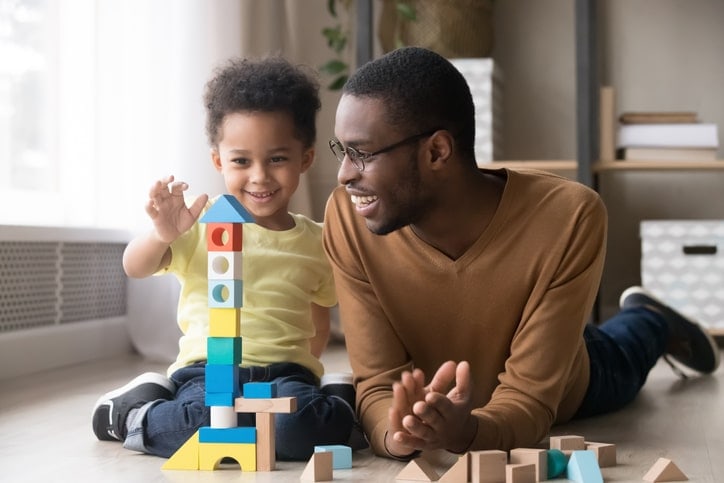
image of father and son playing with blocks by fizkes /istock
Content of “Why Toy Blocks Rock” last modified 12/2/2022. Portions of this text derive from an earlier version of this article, written by the same author.